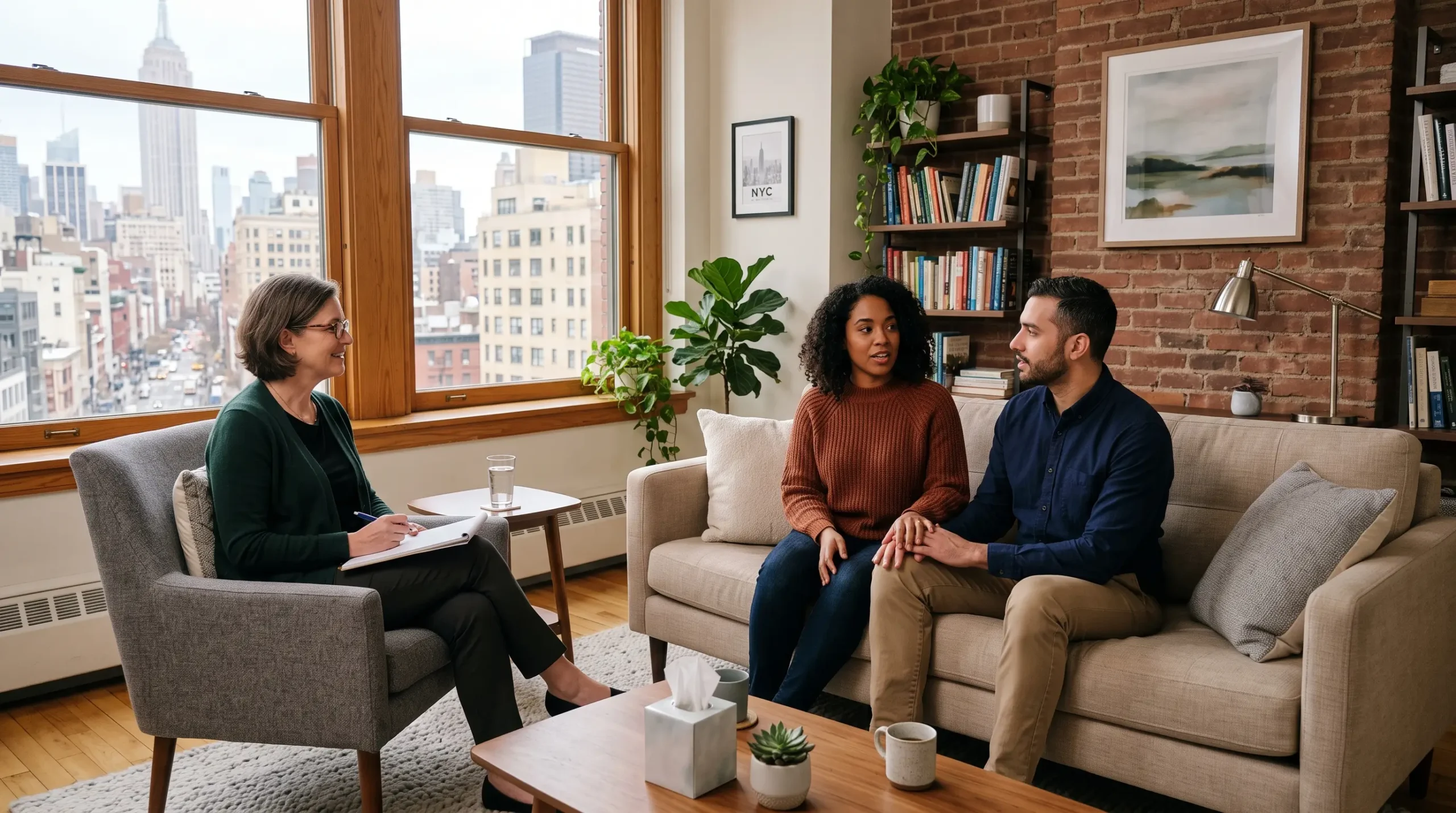

If you’re searching for marriage therapy cost in New York, you’ve already done something brave — you’ve admitted that your relationship could use some help. But then you hit a wall: the prices. New York is one of the most expensive cities in the world, and couples therapy is no exception. Before you close this tab and convince yourself you can’t afford it, read this guide in full. Because the real cost of marriage therapy in New York depends on far more than the number a therapist lists on their website — and there are options at every budget level, from $5 a session to $450 and beyond.
No products are promoted here. No therapists are recommended. This is a neutral, factual resource built for New York couples trying to make an informed decision.
Table of Contents
How Much Does Marriage Therapy Cost in New York?
Let’s start with the number you came for. Marriage therapy cost in New York typically runs between $150 and $450 per session, depending on the therapist’s credentials, location, and specialization. That range is wide, and it’s intentional — because “marriage therapy in New York” covers everything from a sliding-scale trainee in the Bronx to a PhD-level Gottman specialist on the Upper East Side.
To make this more useful, here’s how the market breaks down into three clear tiers:
| Tier | Typical Cost Per Session | Who This Usually Is |
|---|---|---|
| Budget | $100 – $175 | Training clinics, sliding scale therapists, nonprofits |
| Mid-range | $175 – $300 | Licensed LMFT or LCSW in private practice |
| Premium | $300 – $450+ | PhD/PsyD, specialized certifications, Manhattan offices |
A few things worth understanding right away. First, couples sessions are almost always priced higher than individual sessions — typically by $50 to $100 more per hour. This is because the therapist is managing two people’s emotional responses, communication patterns, and relationship history simultaneously. It is a significantly more demanding format than one-on-one work.
Second, New York City rates run 40 to 60 percent above the national average for the same credential level. That gap exists because of office rent, the concentration of high-demand specialists, and the general cost of living. A licensed marriage and family therapist charging $200 per session in New York would likely charge $130 to $150 for the same work in another major U.S. city.
Third, session length affects price more than most people realize. Standard individual therapy runs 45 to 50 minutes. Most couples sessions run 60 to 90 minutes. Some therapists charge a flat rate regardless of length; others charge per minute beyond the standard hour. Always confirm session length before booking.
Marriage Therapy Cost by NYC Borough — and Neighborhood
One of the biggest mistakes New Yorkers make when researching marriage therapy cost in New York is treating the city as a single market. It isn’t. A couples therapist in Park Slope charges differently than one in Bushwick. A practice in Riverdale costs more than one in the South Bronx. Borough and neighborhood matter enormously — and this section goes deeper than anything else you’ll find online.
Manhattan
Manhattan is the most expensive borough for marriage therapy, with rates typically falling between $250 and $450+ per session. But even within Manhattan, there is meaningful variation by neighborhood:
- Midtown, Upper East Side, Upper West Side: $350 – $450+. This is where many of New York’s most credentialed specialists maintain offices, and the rent they pay reflects it.
- Downtown Manhattan, Chelsea, West Village, Tribeca: $275 – $375. Slightly more affordable than the Upper East Side, but still premium.
- Harlem, Washington Heights, Inwood: $175 – $300. More affordable private practice options exist here, and community mental health centers are more prevalent.
Brooklyn
Brooklyn has the widest price range of any borough, reflecting its economic and geographic diversity. Overall, expect $175 to $400 per session in private practice.
- Park Slope, DUMBO, Williamsburg, Carroll Gardens: $250 – $400. These neighborhoods attract experienced therapists whose client base can support Manhattan-adjacent rates.
- Crown Heights, Flatbush, Bushwick, Bed-Stuy: $150 – $250. A productive mid-range zone with genuine private practice quality.
- Bensonhurst, East Flatbush, Bay Ridge, Canarsie: $100 – $200. The most affordable in-person private practice options in Brooklyn, with nonprofit resources more readily available.
Queens
Queens offers solid private practice options at more accessible rates, generally $150 to $300 per session.
- Astoria, Long Island City, Forest Hills, Bayside: $175 – $300, with a growing number of multilingual and culturally specific practices.
- Flushing, Jackson Heights, Jamaica, Corona: $100 – $200. Community health clinics are prominent here, and there are more therapists serving immigrant and bilingual communities.
The Bronx
The Bronx offers some of the most affordable in-person therapy in the city, with private practice rates running $100 to $250 per session.
- Riverdale, Fieldstone: $175 – $300, with a concentration of private practices serving the area’s higher-income residents.
- South Bronx, Hunts Point, Mott Haven: Sliding scale and nonprofit options are most common here, and training clinic access is easiest through Ferkauf Graduate School (covered in the affordable options section below).
Staten Island
Staten Island tends to be the most affordable borough for in-person private practice, with rates generally running $100 to $250 per session. The trade-off is fewer specialists — particularly in modalities like EFT or Gottman Method. Many Staten Island couples choose to see a Manhattan or Brooklyn therapist via telehealth rather than travel, which keeps access to specialized care open without the commute.
A Note on Telehealth Within New York State
Online couples therapy has grown enormously, and many New York therapists now offer both in-person and video sessions at the same rate. Telehealth does not automatically mean cheaper — most private practice therapists charge identical rates regardless of format. However, online-only platforms tend to offer lower entry rates, and those options are covered in the affordable options section. One important point: any therapist providing therapy to a New York resident must be licensed in New York State, regardless of where the therapist is physically located.
What Drives the Cost of Marriage Therapy in NYC?
Understanding why marriage therapy costs what it does in New York helps you evaluate whether a given price is reasonable — and what you’re actually paying for. There are five main cost drivers.
Therapist Credential Type
The letters after a therapist’s name reflect different training paths, and each comes with a different typical price bracket:
| Credential | What It Means | Typical NYC Rate |
|---|---|---|
| PhD / PsyD | Doctoral-level psychologist, 5–7 years post-grad training | $300 – $450+ |
| LMFT | Licensed Marriage and Family Therapist, master’s level, specialty in relational work | $175 – $350 |
| LCSW / LPC | Licensed Clinical Social Worker or Licensed Professional Counselor, master’s level | $150 – $300 |
| Graduate trainee | Supervised pre-licensure clinician (training clinics) | $5 – $100 |
One critical point worth emphasizing: credential type does not equal quality for couples work. An LMFT with advanced Gottman training and ten years of couples-specific experience will likely outperform a PhD who primarily sees individuals and occasionally takes couples. Specialization and fit matter more than the degree on the wall.
Specialized Training and Certification
Beyond the base license, therapists who pursue advanced couples-specific training command higher rates — and for legitimate reasons. These certifications require hundreds of hours of additional training, supervised practice, and ongoing continuing education. Here’s how the main ones break down:
- Gottman Method: A three-level certification program. Level 1 is an introductory workshop; Level 3 certification (the highest) requires years of study and supervised practice and commands the highest fees — often adding $50 to $100 per session above a therapist’s base rate.
- Emotionally Focused Therapy (EFT): Externship and core skills training through the International Centre for Excellence in EFT. Certified EFT therapists typically add $25 to $60 per session to their base rate.
- Imago Relationship Therapy: Certification requires 100+ hours of training. Imago-certified therapists typically add $20 to $50 above base rate.
- Discernment Counseling: A specialized, brief format (1–5 sessions) for couples who are uncertain whether to stay together. This is a separate skill set from ongoing couples therapy and is typically priced per-session at standard rates.
Session Length
Most couples therapy sessions run 60 to 90 minutes rather than the 45-minute individual standard. Some therapists bill a flat rate for this extended session; others charge their standard rate plus a prorated amount for the additional time. When comparing therapists by price, always confirm the session length that rate covers.
For couples who want faster progress, some therapists offer intensive formats — half-day or full-day sessions that compress months of weekly work into a concentrated period. These typically cost between $800 and $3,000 for the intensive itself, but can reduce overall treatment length significantly.
NYC Office Overhead
This is the cost factor most people overlook. Renting a single therapy room in a Manhattan office building can cost $3,000 to $8,000 per month. Add licensing fees, malpractice insurance, continuing education requirements, Electronic Health Record software, and billing costs — and a private practice therapist in Manhattan is carrying significant overhead before seeing their first client of the week. That overhead is reflected in the session fee, which is part of why the same therapist would charge $50 to $150 less if they relocated to Queens or Brooklyn.
The Hidden Cost of a Poor Match
No competitor covers this, but it’s one of the most important cost factors of all. Choosing the wrong therapist — even a cheaper one — can cost you significantly more in the long run. If you spend eight sessions with a therapist who isn’t the right fit before starting over with someone else, you’ve paid for sixteen sessions to get the benefit of eight. Checking for specialization and doing a free consultation before committing (covered in the “how to find a therapist” section) is one of the best investments you can make.
Total Cost of Marriage Therapy in NYC: Realistic Budget Scenarios
Per-session price only tells part of the story. What couples actually spend depends on how many sessions they need, how frequently they attend, and whether insurance contributes. Most couples in therapy attend somewhere between 12 and 24 sessions — though shorter courses of 6 to 8 sessions exist for specific, well-defined issues, and longer courses are common for more complex situations like recovering from infidelity.
Here are five realistic budget scenarios for New York couples:
| Scenario | Sessions | Rate | Gross Cost | Est. With Insurance |
|---|---|---|---|---|
| Short-term (budget) | 8 weekly | $175 | $1,400 | $420 – $840 |
| Standard (mid-range) | 16 mixed | $250 | $4,000 | $1,200 – $2,400 |
| Standard (premium) | 16 mixed | $350 | $5,600 | $1,680 – $3,360 |
| Long-term | 24 biweekly | $300 | $7,200 | $2,160 – $4,320 |
| Intensive format | 1–2 day retreat | flat | $1,500 – $3,000 | Varies |
The insurance estimate column assumes 30 to 60 percent reimbursement through out-of-network benefits, which is a realistic range for New York plans — but individual plans vary considerably. The insurance section below explains exactly how to find out what your plan covers.
The Divorce Comparison
This comparison is not meant to pressure anyone — it’s simply factual context. The average divorce in New York State costs between $15,000 and $30,000 in legal fees alone, not counting the financial restructuring, housing changes, and long-term impact on children. A full course of couples therapy, even at premium Manhattan rates, represents a fraction of that cost. Whether therapy is the right path is a personal decision — but it is worth understanding the financial scale of the alternative.
Does Insurance Cover Marriage Therapy in New York?
This is the question most New Yorkers have but struggle to get a straight answer on. Here’s the honest version: insurance companies do not technically cover “marriage therapy” or “couples counseling” as a standalone service. But in practice, many couples get significant insurance coverage anyway — through a mechanism that is legal, widely used, and worth understanding.
The Billing Code Workaround: CPT 90847
When a therapist bills insurance for couples work, they typically use CPT (Current Procedural Terminology) code 90847 — “family psychotherapy, conjoint psychotherapy with patient present.” This code allows insurance billing when one partner in the couple has a covered mental health diagnosis — such as Adjustment Disorder, Generalized Anxiety Disorder, or Major Depressive Disorder.
In practical terms: if one partner has a condition that qualifies for mental health coverage under your plan, and the therapist uses this billing code, the sessions may be covered as mental health treatment rather than relationship counseling. Not every therapist uses this approach — some decline for ethical or administrative reasons — so it is worth asking directly before assuming coverage.
In-Network vs. Out-of-Network: The Real Difference
Most of New York’s best-credentialed couples therapists are out-of-network providers. This is common across the mental health field because insurance reimbursement rates are often too low to sustain a specialized private practice in a high-cost city. Here’s what that means practically:
In-network coverage:
- You pay a copay ($20 – $80 per session) after your deductible is met
- The therapist handles all billing directly with your insurer
- Fewer specialists tend to be in-network, particularly for couples work
Out-of-network coverage:
- You pay the full session rate upfront
- Your insurer reimburses you 40 to 70 percent after your deductible
- You submit a superbill (explained below) to claim reimbursement
- More specialized therapists are accessible through this route
What Is a Superbill and How Do You Use It?
A superbill is an itemized receipt provided by your therapist that contains everything your insurance company needs to process a reimbursement claim. It must include:
- The therapist’s name, NPI (National Provider Identifier) number, and license
- The date(s) of service
- The CPT billing code (typically 90847 for couples sessions)
- The diagnosis code (ICD-10 code for the covered condition)
- The fee charged
Here’s the process step by step:
- After each session (or monthly), request a superbill from your therapist
- Log into your insurance portal or call your member services line
- Submit the superbill according to your plan’s out-of-network claims process (usually online upload or mail)
- Receive a reimbursement check, typically within 30 to 45 days for New York plans
The Privacy Trade-Off
Using insurance for couples therapy — whether in-network or out-of-network — requires that one partner receive a mental health diagnosis. That diagnosis becomes part of their permanent medical record. For most people this is a non-issue, but it can have implications for certain types of employment background checks, life insurance applications, or future insurance coverage.
This is why many New York couples — particularly those in finance, law enforcement, or other sensitive industries — choose to pay entirely out of pocket, even when insurance coverage is available. Neither choice is universally right. Understanding the trade-off is what matters.
The 6 Questions to Ask Your Insurer Before Booking a Therapist
Call the member services number on the back of your insurance card and ask exactly these questions:
- Do I have out-of-network mental health benefits under my plan?
- What is my out-of-network deductible for mental health services, and how much have I met?
- What is my reimbursement rate (coinsurance) after the deductible?
- Is CPT code 90847 covered under my plan?
- Is there a session limit per calendar year for mental health services?
- How do I submit an out-of-network claim, and what is the deadline for submission?
Write down the name of the representative you speak with and the date of the call. Insurance companies occasionally give incorrect information, and having a record protects you.
Can You Use HSA or FSA Funds for Marriage Therapy in New York?
This is the most overlooked cost-reduction tool in the entire guide — and not a single competing article mentions it. If you or your partner has a Health Savings Account (HSA) or Flexible Spending Account (FSA) through your employer, you may be able to pay for couples therapy entirely with pre-tax dollars.
Here’s how it works. The IRS allows HSA and FSA funds to be used for medical expenses, including mental health treatment. The same condition that makes couples therapy billable through insurance — a covered mental health diagnosis on one partner — also makes it eligible for HSA and FSA reimbursement. If your therapist uses CPT code 90847 and one partner has a qualifying diagnosis, the sessions qualify as a medical expense.
FSA vs. HSA: the key difference for New Yorkers:
- FSA (Flexible Spending Account): Use it or lose it within the plan year. Funds are available immediately. Contribution limit set by employer plan.
- HSA (Health Savings Account): Rolls over indefinitely year to year. Only available with high-deductible health plans. Contributions grow tax-free.
Most therapists accept HSA and FSA debit cards directly as payment. If your therapist does not accept the card directly, you pay out of pocket and submit the superbill to your HSA or FSA administrator for reimbursement — the same process as with insurance.
To illustrate the savings: if you spend $3,000 on couples therapy and you’re in the 24 percent federal tax bracket, paying with pre-tax HSA or FSA dollars saves you approximately $720. For New York City residents, who also pay state and city income taxes, the effective savings can exceed $900 on that same $3,000.
What to ask your HR department:
- Does my health plan include FSA or HSA options?
- What is the annual contribution limit?
- Does my plan cover mental health treatment under HSA/FSA?
- Does my specific insurer require a diagnosis code for HSA/FSA reimbursement?
New York’s large employer base in finance, tech, media, and healthcare means a significant portion of NYC residents have access to generous HSA or FSA benefits. Check your benefits portal before assuming you’re paying full out-of-pocket.
Affordable and Low-Cost Marriage Therapy Options in New York City
One of the most frustrating things about most guides to marriage therapy cost in New York is that they either ignore affordable options entirely or mention them so vaguely they’re useless. This section is different. There are real, named, accessible options at every price point across all five boroughs — and here is where to find them.
The market breaks into three tiers: training clinics (lowest cost), sliding scale private practice, and community or nonprofit resources.
Training Clinics: The Most Affordable Option in NYC
Training clinics are therapy centers attached to graduate psychology programs. Sessions are conducted by advanced graduate students or pre-licensure clinicians under close supervision by licensed faculty. The supervision model is rigorous — in many cases, your therapist is being observed and coached in real time. The quality is often genuinely excellent, and the cost is a fraction of private practice.
Named training clinics in New York City:
- Ferkauf Graduate School Parnes Clinic — Yeshiva University, Bronx. Sessions run approximately $5 to $40 per session on a sliding scale. One of the most accessible low-cost options in the city, with no one turned away for financial reasons.
- CCNY Psychological Center — City College of New York, Harlem. Sliding scale fees for couples and individuals, supervised by licensed faculty.
- Albert Ellis Institute — Multiple NYC locations. Offers sliding scale rates for couples using CBT and REBT (Rational Emotive Behavior Therapy) approaches. Strong training program with a clear evidence base.
- Blanton-Peale Institute — Yorkville, Manhattan. Approximately $60 per session ($80 for the intake session). Accepts Medicaid. One of the city’s longest-running community counseling institutions.
Sliding Scale Private Practice Therapists
Many licensed private practice therapists in New York reserve a portion of their caseload for sliding scale clients — meaning they adjust their fee based on your household income. This is more common than people realize, and the rates can be significantly lower than the therapist’s standard fee.
The typical sliding scale range in NYC is $75 to $150 per session, compared to the therapist’s standard rate of $200 to $350. Here’s how to access it:
Where to search:
- Psychology Today (psychologytoday.com) — filter by “sliding scale” under the cost section
- Open Path Collective (openpathcollective.org) — a vetted network of therapists offering $30 to $80 per session for qualifying clients
- Zencare (zencare.co) — NYC-specific therapist directory with detailed filtering
How to ask: When contacting a therapist, simply say: “I’m very interested in working with you. I don’t see your fee listed — do you have sliding scale availability, and if so, what range do you work within?” Most therapists who offer sliding scale respond straightforwardly to this question.
Community Mental Health Centers
New York City funds and supports a network of community mental health resources. These are often underutilized because people don’t know they exist.
- NYC Well (nyc.gov/nycwell) — A free, 24/7 mental health support line funded by the city. Provides short-term counseling, crisis support, and referrals to long-term providers. Call 888-NYC-WELL.
- Mayor’s Office of Community Mental Health — Maintains a borough-by-borough resource directory for low-income New Yorkers.
- NAMI-NYC (naminyc.org) — Free programs, support groups, and referral services for couples and families.
- Medicaid-accepting practices — All five boroughs have private practice therapists who accept Medicaid. Use the New York State Medicaid provider directory to search by specialty and location.
Faith-Based and Culturally Specific Options
New York’s extraordinary cultural diversity is reflected in its therapy landscape. Many religious institutions — churches, synagogues, mosques — offer low-cost or free couples counseling through clergy or affiliated counselors. Quality varies, and these are typically most appropriate for couples whose faith is central to their relationship.
For couples seeking culturally specific care, the following directories are helpful:
- Therapy for Black Girls (therapyforblackgirls.com) — includes couples therapists
- Latinx Therapy (latinxtherapy.com) — Spanish-speaking and bicultural therapists
- National Queer and Trans Therapists of Color Network (nqttcn.com) — LGBTQ+-affirming therapists of color
Group Couples Therapy
An underused option that deserves more attention. Group couples therapy typically brings two to four couples together for a session facilitated by a licensed therapist. The format is not for everyone — it requires a degree of comfort sharing your relationship dynamics with strangers — but it offers several advantages:
- Cost is typically 40 to 60 percent lower than individual couples sessions
- Hearing other couples work through similar issues can normalize your own struggles
- Group settings can be especially effective for communication-focused work
Group couples therapy is generally not appropriate for couples in acute crisis, managing active infidelity, or dealing with domestic violence concerns. For those situations, individual couples therapy is the right environment.
Marriage Therapy Approaches in NYC: What Each Costs and Who It’s Best For
When you search for a couples therapist in New York, you’ll encounter names like “Gottman Method,” “EFT,” and “Imago” on nearly every profile. These are therapeutic modalities — distinct approaches to how couples therapy is structured and delivered. They affect both what the therapy experience feels like and, to some extent, what it costs.
| Approach | What It Is | Cost Premium (NYC) | Best For | Research Strength |
|---|---|---|---|---|
| Gottman Method | Research-based tools for communication and conflict | +$25 – $75/session | Conflict patterns, communication breakdown | Very strong |
| EFT (Emotionally Focused Therapy) | Attachment-based work on emotional connection | +$20 – $60/session | Emotional distance, trust, trauma | Very strong |
| Imago Relationship Therapy | Connects adult conflict patterns to childhood experience | +$15 – $50/session | Recurring conflict, childhood wounds | Moderate |
| CBT-based Couples Therapy | Restructures thought and behavior patterns | Minimal premium | Specific behavioral issues | Strong |
| Discernment Counseling | For couples uncertain about whether to stay together | No premium; 1–5 sessions only | Couples considering separation | Specific use case |
| Premarital Counseling | Prevention-focused work before marriage | Often lower than standard rates | Engaged couples | Strong |
A few things worth understanding about this table. First, the cost premiums reflect the reality that advanced training in these modalities takes years and thousands of dollars of investment on the therapist’s part. Second, most experienced couples therapists integrate elements of multiple approaches rather than rigidly adhering to one. Third — and most importantly — you do not need to choose a modality before finding a therapist. Ask what approaches a therapist draws on and why, rather than searching exclusively for one method.
The strongest predictor of couples therapy success is not the modality used — it’s the therapeutic alliance, meaning how safe and understood both partners feel with the therapist. That quality is best assessed through a consultation, not a directory filter.
Is Marriage Therapy Worth the Cost in New York?
This is the question underneath every price question in this guide. It deserves a straight, honest answer rather than a sales pitch.
Research consistently shows that roughly 70 to 75 percent of couples who complete a course of therapy report meaningful improvement in their relationship — reduced conflict frequency, restored emotional connection, improved communication, and greater relationship satisfaction. These are not minor changes; couples therapy, when done well and when both partners engage genuinely, produces substantial results.
It is also true that therapy does not save every marriage — and that is not always a failure. Some couples come to therapy, do the work honestly, and conclude that separation is the healthiest path forward for both of them. Therapy can help that process happen with more clarity and less destruction than it would otherwise. Knowing what you’re in and making a conscious choice, rather than drifting, has real value.
The Six-Year Delay Problem
Research by Dr. John Gottman found that the average couple waits six years after serious relationship problems develop before seeking professional help. Six years of accumulated resentment, entrenched conflict patterns, and emotional distance make the therapeutic work significantly harder — and often longer, which means more expensive. The couples who get the most value from therapy, both in outcomes and in cost-efficiency, are typically those who come earlier rather than later.
The One-Reluctant-Partner Reality
Most guides to marriage therapy assume both partners are equally motivated. That is often not how it works. In many New York couples, one partner initiates the search for therapy — often the one doing this research right now — while the other is ambivalent, resistant, or outright opposed.
This dynamic is worth addressing honestly. Research does suggest that therapy is more effective when both partners are genuinely engaged. But “genuine engagement” can develop over the course of treatment, even when it doesn’t exist at the start. Discernment counseling, mentioned above, is specifically designed as a low-stakes entry point for couples where one partner is uncertain — it’s a structured, limited process (1 to 5 sessions) focused on deciding whether to pursue full couples therapy, not on fixing the relationship yet.
If your partner is reluctant, it may be worth framing the first few sessions not as “therapy” but as a structured conversation with a neutral professional — someone neither of you chose, who has no stake in the outcome.
The Financial ROI in Plain Terms
- A full course of marriage therapy in New York: $1,400 to $7,200 (before insurance)
- Average cost of divorce in New York State: $15,000 to $30,000+ in legal fees alone
- Additional divorce-related costs: housing changes, split retirement accounts, child custody arrangements, long-term co-parenting structure
The comparison is not an argument that couples must stay together at all costs. It is simply factual context. For couples who are genuinely uncertain whether their relationship can be repaired, the financial case for attempting therapy before divorce proceedings is substantial.
How to Find a Marriage Therapist in New York Without Overpaying
Now that you understand what marriage therapy cost in New York looks like, the final question is how to find the right therapist at the right price. This section gives you a step-by-step process.
Step 1 — Define Your Non-Negotiables Before You Search
Before opening a single directory, get clear on what matters most to your situation:
- Budget: What is your maximum per-session budget? And do you have a rough ceiling for total investment?
- Format: In-person only, telehealth only, or open to both?
- Insurance: Must the therapist be in-network, or are you open to superbill reimbursement?
- Location: Which borough or neighborhood is most practical for weekly or biweekly appointments?
- Specialization: Do you have specific needs — LGBTQ+ affirming care, bilingual sessions, experience with infidelity or neurodiversity, or a specific modality?
Being clear on these filters before you search saves hours of back-and-forth with therapists who aren’t the right fit.
Step 2 — Where to Search in New York City
These directories are the most useful for NYC couples:
- Psychology Today (psychologytoday.com/us/therapists) — The most comprehensive directory. Filter by borough, insurance accepted, sliding scale, and specialty. Look for therapists whose profiles explicitly mention couples or relationship therapy as a focus.
- Zocdoc (zocdoc.com) — Shows real-time availability and verified patient reviews. Useful for seeing who actually has openings.
- Zencare (zencare.co) — NYC-specific, with vetted therapists and short video introductions. Particularly useful for getting a sense of personality and communication style before reaching out.
- Open Path Collective (openpathcollective.org) — For sliding scale sessions at $30 to $80. Therapists must apply and be vetted to join.
- Your insurance carrier’s directory — For in-network options. Filter by specialty (look for “marriage and family therapy” or “couples counseling”) and verify the listing is current before booking.
Step 3 — Questions to Ask a Therapist Before Booking
Most therapists offer a free 15- to 20-minute consultation call. Use it well. These six questions will tell you most of what you need to know:
- “Is couples therapy your primary focus, or do you also work with individuals?” Specialists who primarily do couples work are meaningfully different from general therapists who occasionally see couples.
- “What specific training do you have in couples therapy?” Look for named certifications (EFT, Gottman, Imago) rather than general answers.
- “What are your rates, and do you offer a sliding scale or reduced fee arrangements?”
- “Do you accept [my insurer], or do you provide superbills for out-of-network reimbursement?”
- “What does a typical course of treatment look like for couples in your practice?” A good therapist can give you a realistic sense of timeline without overpromising.
- “Can you describe your general approach to how you work with couples?” This question reveals therapeutic philosophy and whether it aligns with what you’re looking for.
Step 4 — Red Flags to Watch For
A few warning signs that a therapist may not be the right choice for couples work:
- No clear specialty in couples therapy. General therapists who “also see couples” lack the relational training that makes couples work effective.
- Vague or evasive answers about approach. A skilled therapist should be able to explain their therapeutic framework clearly.
- Unclear or inconsistent fee structure. If discussing money feels difficult before therapy even starts, it’s worth noting.
- Early alliance with one partner. A couples therapist should maintain consistent neutrality. If you feel consistently positioned as the “problem partner” in early sessions, trust that instinct.
- No discussion of goals or structure. Effective couples therapy is purposeful. If sessions feel directionless after two or three visits, raise it directly — or consider whether the fit is right.
Frequently Asked Questions: Marriage Therapy Cost in New York
How much is one marriage therapy session in New York City? A single session of marriage therapy in New York City costs between $150 and $450, depending on the therapist’s credentials, location, and specialization. Budget-tier options (training clinics, sliding scale therapists) run $75 to $175. Mid-range private practice therapists charge $175 to $300. Premium specialists with advanced certifications or Manhattan offices typically charge $300 to $450 or more.
Does health insurance cover marriage therapy in New York? Not directly — insurance companies don’t cover “couples counseling” as a category. However, many therapists bill using CPT code 90847 (family/conjoint psychotherapy) when one partner has a covered mental health diagnosis, which can make sessions reimbursable. Out-of-network benefits can cover 40 to 70 percent of the cost through superbill reimbursement.
What is the cheapest couples therapy option in NYC? Training clinics attached to graduate psychology programs offer the lowest-cost sessions in the city. Ferkauf Graduate School’s Parnes Clinic in the Bronx charges $5 to $40 per session on a sliding scale. The Albert Ellis Institute and CCNY Psychological Center also offer low-cost sliding scale options. Open Path Collective connects couples with vetted therapists at $30 to $80 per session.
Can I use my FSA or HSA card for couples therapy in New York? Yes, in most cases — provided the sessions are billed under a qualifying mental health diagnosis and CPT code. Most therapists accept HSA and FSA cards directly as payment. If yours does not, pay out of pocket and submit the superbill to your HSA or FSA administrator for reimbursement. This can produce savings of $700 to $1,000 or more on a full course of treatment.
How many sessions does marriage therapy usually take? Most couples attend between 12 and 24 sessions. Shorter courses of 6 to 8 sessions exist for well-defined, specific issues. Longer courses — 30 sessions or more — are common for significant trust ruptures (such as infidelity) or longstanding patterns that have developed over many years. Session frequency typically starts weekly and shifts to biweekly as progress is made.
Is online marriage therapy cheaper than in-person in New York? Not automatically. Most private practice therapists in New York charge the same rate for telehealth as for in-person sessions. Online-only platforms (such as Regain or ReGain) can offer lower entry rates, but vet the therapist’s credentials and specialization carefully before committing. The format — online or in-person — matters less than the therapist’s couples-specific training and fit with your dynamic.
What is a superbill and how do I get one from my therapist? A superbill is an itemized receipt containing your therapist’s NPI number, the CPT billing code, the diagnosis code, and the service date and fee. You submit it to your insurance company to claim out-of-network reimbursement. Simply ask your therapist: “Do you provide superbills for out-of-network insurance reimbursement?” Most do. Reimbursement typically arrives within 30 to 45 days.
What’s the difference between an LMFT and a psychologist for couples therapy? An LMFT (Licensed Marriage and Family Therapist) has master’s-level training with a specific focus on relational and family systems work. A psychologist (PhD or PsyD) has doctoral-level training with a broader clinical scope. For couples therapy specifically, the LMFT’s relational specialization often makes them the stronger choice — though individual fit, couples-specific training, and certifications (Gottman, EFT) matter more than either credential alone.
Does couples therapy work if only one partner wants to go? Research suggests therapy is more effective when both partners are genuinely motivated — but “genuinely motivated” can develop over the course of treatment, even when it’s absent at the start. Discernment counseling is a structured, low-stakes option (1 to 5 sessions) designed specifically for couples where one partner is ambivalent, and can be a productive first step before committing to full couples therapy.
How much does Gottman Method therapy cost in New York? Gottman-certified therapists in New York typically charge $25 to $100 per session above their standard rate, reflecting their advanced certification. In Manhattan, this often means $325 to $500 per session for a Level 3 certified Gottman therapist. In Brooklyn or Queens, expect $225 to $375 for the same credential level.
Are there free or very low-cost couples therapy options in New York City? Yes. NYC Well (888-NYC-WELL) offers free short-term counseling and referrals. NAMI-NYC provides free programs and support. Training clinics at Ferkauf, CCNY, and the Albert Ellis Institute offer sessions from $5 to $60. Open Path Collective lists vetted therapists at $30 to $80. Community mental health centers in all five boroughs accept Medicaid, and many religious institutions offer free or low-cost couples counseling.
How do I find a sliding scale couples therapist in New York? Search Psychology Today with the “sliding scale” filter selected, or browse Open Path Collective. When contacting any therapist, it’s always acceptable to ask directly: “Do you have sliding scale availability, and what range do you work within?” Most therapists who offer it appreciate the direct question. Sliding scale rates in NYC typically run $75 to $150 per session.
Closing: What You Actually Need to Know
Marriage therapy cost in New York is real, and it is genuinely higher than in most other parts of the country. But the full picture is more manageable than the sticker price suggests. Sessions run from $5 to $450 depending on the route you take. Insurance, HSA, and FSA options can reduce costs by 30 to 70 percent. Training clinics and sliding scale practices make quality couples therapy accessible at almost any income level. And the total cost of a full course of therapy, even at mid-range Manhattan rates, is a fraction of what relationship breakdown ultimately costs — financially and otherwise.
There is an option at every budget level in every borough. Use the checklist in the “How to Find a Therapist” section to start your search with clarity about what you need, what you can spend, and what questions to ask.
Rates and resources in this guide reflect current market conditions in New York City and are reviewed regularly. If you find outdated information, costs change frequently in this market — always confirm fees directly with any provider before booking.