

You’re about to take your child to a pediatrician in New York, but the nagging worry about cost won’t go away. Will insurance cover it? What if you don’t have insurance? Why does your neighbor in Manhattan pay three times what your cousin in Buffalo pays for the same visit?
Understanding pediatrician cost in New York doesn’t have to be overwhelming. This comprehensive guide reveals exactly what you’ll pay across every region of New York State—from the Bronx to Buffalo—and shows you proven strategies to slash your out-of-pocket expenses.
Here’s what you’ll discover:
- Actual costs you’ll pay for pediatrician visits across New York (with real numbers by borough and city)
- How insurance transforms your bill from $300 to $0
- Free and low-cost pediatric care options hiding in plain sight
- Step-by-step guidance to find affordable care, even without insurance
- Money-saving strategies that put hundreds of dollars back in your pocket
Whether you’re navigating Medicaid in the Bronx, comparing private practices in Westchester, or searching for sliding-scale clinics upstate, this guide gives you the pricing transparency you deserve.
Let’s dive into the real costs of pediatric care in New York—and how to afford it.
Table of Contents
Understanding Pediatrician Visit Types & What They Cost
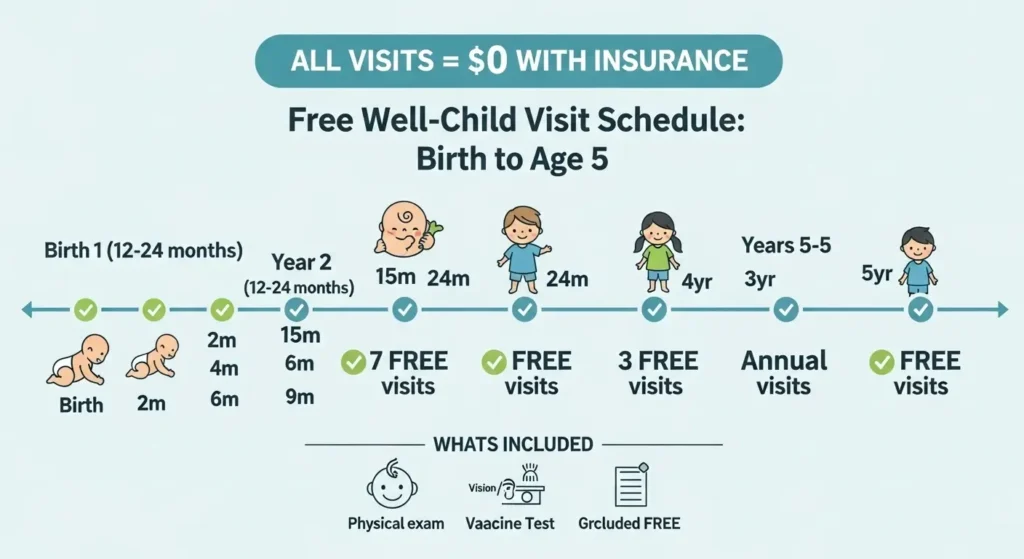
Before we break down pediatrician cost in New York by region, you need to understand what you’re paying for. Not all pediatric visits are created equal, and the type of visit dramatically affects your final bill.
Well-Child Visits (Preventive Care)
Well-child visits are the cornerstone of pediatric care. These scheduled checkups monitor your child’s growth, development, and overall health.
What’s included:
- Complete physical examination
- Developmental and behavioral screenings
- Growth measurements (height, weight, head circumference)
- Vision and hearing tests
- Age-appropriate counseling on nutrition, safety, and sleep
Recommended schedule:
- First year: Birth, 1 month, 2 months, 4 months, 6 months, 9 months, 12 months (7 visits)
- Second year: 15 months, 18 months, 24 months (3 visits)
- Ages 3-21: Annual checkups (19 visits)
Cost breakdown:
- With insurance: $0-$30 copay (most plans cover at $0 under ACA preventive care)
- Without insurance in NYC: $150-$300 per visit
- Without insurance upstate: $100-$200 per visit
Here’s the great news: Well-child visits are covered at 100% by all ACA-compliant insurance plans when you use an in-network provider. This includes standard vaccinations administered during these visits.
Sick Visits
When your child wakes up with a fever, ear pain, or persistent cough, you’ll need a sick visit. These are unscheduled appointments addressing acute illness or injury.
Common reasons for sick visits:
- Ear infections
- Strep throat
- Respiratory infections (colds, flu, bronchitis)
- Stomach issues (diarrhea, vomiting)
- Rashes and skin conditions
- Minor injuries
Cost breakdown:
- With insurance: $20-$50 copay
- Without insurance in NYC: $150-$250 per visit
- Without insurance upstate: $100-$175 per visit
Additional costs to anticipate:
- Strep test: $25-$75 (often $0-$20 with insurance)
- Flu test: $40-$80 (often $10-$30 with insurance)
- Urinalysis: $30-$100 (often $0-$30 with insurance)
- Prescriptions: $5-$50 depending on medication and insurance
New Patient Appointments
Your child’s first visit to a new pediatrician typically costs more because it involves comprehensive history-taking and establishing a care relationship.
What’s included:
- Detailed medical history review
- Family health history
- Complete physical examination
- Discussion of concerns and care philosophy
- Records transfer coordination
Cost breakdown:
- With insurance: $30-$50 copay
- Without insurance in NYC: $200-$400
- Without insurance upstate: $150-$300
Money-saving tip: Schedule your new patient visit as a well-child checkup if your child is due for one. It’ll be coded as preventive care and covered at 100% with most insurance plans.
Follow-Up Visits
Follow-up appointments check on a previous condition, monitor chronic issues, or adjust medications.
Cost breakdown:
- With insurance: $20-$40 copay
- Without insurance in NYC: $100-$200
- Without insurance upstate: $75-$150
Specialist Referrals
When your pediatrician identifies issues requiring specialized care—developmental delays, severe allergies, chronic conditions, or complex diagnoses—they’ll refer you to a pediatric specialist.
Common pediatric specialists:
- Pediatric allergist/immunologist
- Pediatric cardiologist
- Pediatric endocrinologist
- Pediatric gastroenterologist
- Pediatric pulmonologist
- Developmental-behavioral pediatrician
Cost breakdown:
- With insurance: $40-$75 specialist copay (higher than primary care)
- Without insurance in NYC: $250-$500+ per visit
- Without insurance upstate: $200-$400+ per visit
Insurance note: Most plans require a referral from your pediatrician before covering specialist visits. Always verify this requirement to avoid unexpected bills.
Pediatrician Cost in New York: Regional Price Breakdown
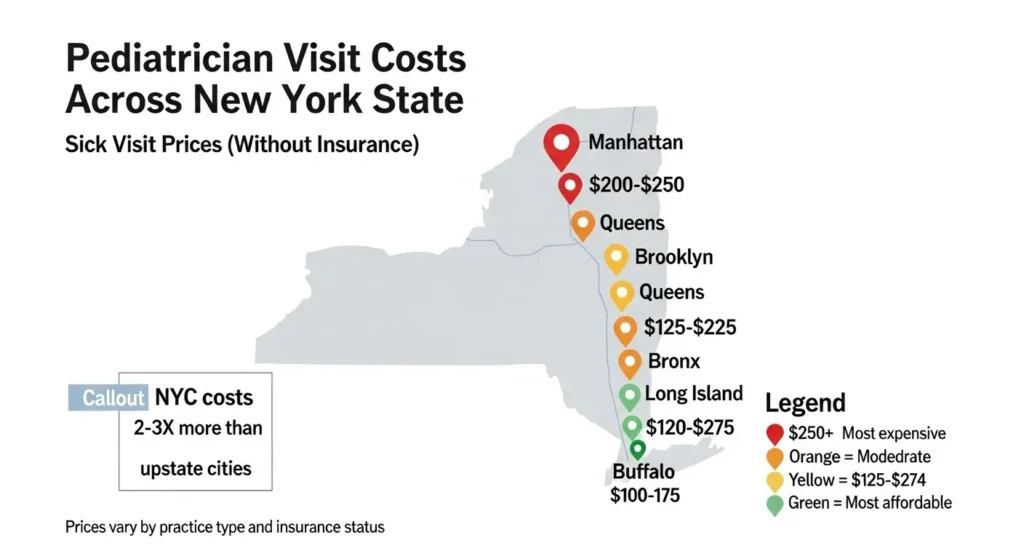
The pediatrician cost in New York varies dramatically based on where you live. A sick visit in Manhattan can cost triple what you’d pay in Syracuse. Here’s your complete regional pricing guide.
New York City: The Five Boroughs
Manhattan
Manhattan pediatricians command the highest prices in New York State, reflecting premium real estate costs, higher operating expenses, and a concentration of concierge-style practices.
Average costs (without insurance):
- New patient visit: $250-$500
- Established patient sick visit: $200-$350
- Well-child visit: $175-$300
- Specialist referral: $300-$600
Neighborhood variations exist: Upper East Side and Tribeca practices often charge 20-30% more than Washington Heights or East Harlem.
With insurance: Most plans have standard copays of $30-$50 regardless of the practice’s full price, which is why staying in-network matters tremendously.
Brooklyn
Brooklyn offers more moderate pricing than Manhattan, though costs vary significantly by neighborhood.
Average costs (without insurance):
- New patient visit: $200-$400
- Established patient sick visit: $150-$275
- Well-child visit: $150-$250
Neighborhood price guide:
- Higher cost areas: Park Slope, DUMBO, Brooklyn Heights, Williamsburg
- Moderate cost areas: Bay Ridge, Sunset Park, Bensonhurst
- Lower cost areas: East New York, Brownsville, Canarsie
Community health centers in Brooklyn offer sliding-scale fees from $0-$50, providing excellent alternatives to high-priced private practices.
Queens
Queens provides diverse options with generally lower prices than Manhattan and Brooklyn’s expensive neighborhoods.
Average costs (without insurance):
- New patient visit: $175-$350
- Established patient sick visit: $150-$250
- Well-child visit: $125-$225
Notable: Queens has numerous community health centers and practices accepting Medicaid, making it easier to find affordable care.
The Bronx
The Bronx typically has the most affordable private practice rates in NYC, plus extensive community health resources.
Average costs (without insurance):
- New patient visit: $150-$300
- Established patient sick visit: $125-$225
- Well-child visit: $125-$200
Major advantage: The Bronx has strong community health infrastructure, including multiple NYC Health + Hospitals locations and FQHCs offering care regardless of ability to pay.
Staten Island
Staten Island’s pediatrician cost falls in the middle range among NYC boroughs.
Average costs (without insurance):
- New patient visit: $175-$325
- Established patient sick visit: $150-$225
- Well-child visit: $125-$200
Surrounding Metro Areas
Long Island (Nassau & Suffolk Counties)
Long Island pediatricians charge rates comparable to outer NYC boroughs, with some variation between the North Shore and South Shore.
Average costs (without insurance):
- New patient visit: $200-$375
- Established patient sick visit: $150-$275
- Well-child visit: $150-$250
Insurance tip: Many Long Island residents work in NYC and have insurance networks that don’t cover Long Island providers well. Always verify in-network status.
Westchester County
Westchester’s affluent communities support pediatric practices with pricing similar to Manhattan.
Average costs (without insurance):
- New patient visit: $200-$400
- Established patient sick visit: $175-$300
- Well-child visit: $150-$275
Geographic note: Southern Westchester (Yonkers, New Rochelle) tends toward lower pricing than northern areas (Scarsdale, Armonk).
Upstate New York: Major Cities
Albany
New York’s capital city offers significantly lower pediatric costs than downstate.
Average costs (without insurance):
- New patient visit: $150-$275
- Established patient sick visit: $125-$200
- Well-child visit: $100-$175
Buffalo
Western New York’s largest city provides some of the state’s most affordable pediatric care.
Average costs (without insurance):
- New patient visit: $125-$250
- Established patient sick visit: $100-$175
- Well-child visit: $100-$150
Rochester
Rochester’s medical community, anchored by strong teaching hospitals, offers competitive pricing.
Average costs (without insurance):
- New patient visit: $125-$250
- Established patient sick visit: $100-$175
- Well-child visit: $100-$160
Syracuse
Central New York provides affordable access to quality pediatric care.
Average costs (without insurance):
- New patient visit: $125-$250
- Established patient sick visit: $100-$175
- Well-child visit: $100-$150
Why Such Dramatic Differences?
The pediatrician cost in New York varies by 200-300% from Manhattan to upstate cities. Here’s why:
NYC pediatricians face:
- Commercial rent: $50-$200+ per square foot annually
- Higher malpractice insurance: 40-60% more than upstate
- Elevated staffing costs: Receptionists, nurses, and medical assistants command NYC wages
- Increased operational expenses: Utilities, supplies, and services cost more
Upstate pediatricians benefit from:
- Lower real estate costs: $10-$30 per square foot
- Reduced malpractice premiums
- Lower salary requirements for staff
- Generally lower cost of doing business
Bottom line: Your ZIP code can determine whether you pay $100 or $300 for the same pediatric visit—making insurance coverage and knowledge of low-cost alternatives absolutely critical.
How Insurance Affects Your Pediatrician Cost in New York
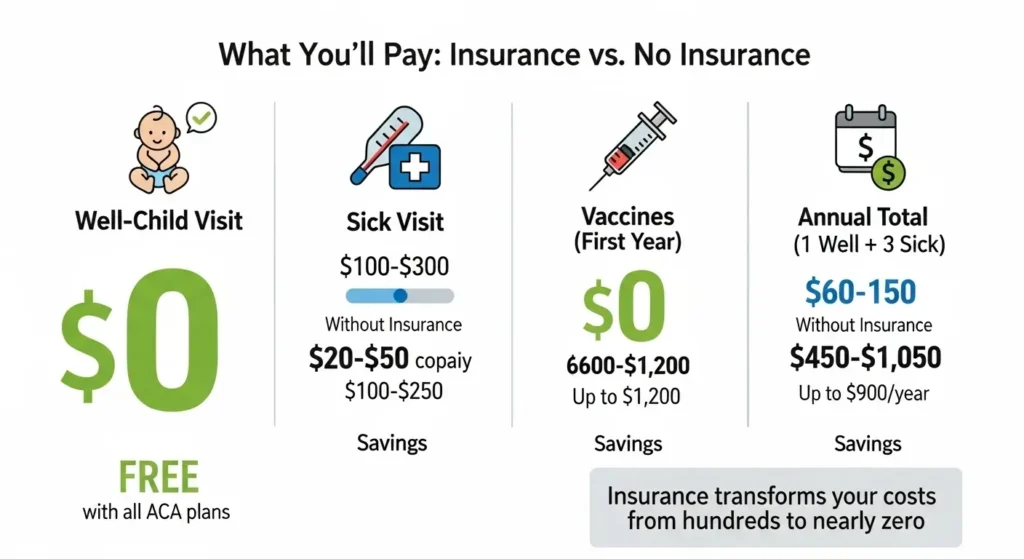
Insurance transforms the pediatrician cost in New York from potentially unaffordable to manageable. Understanding how your coverage works saves you hundreds of dollars annually.
Understanding Your Insurance Coverage: Key Terms
Before you can navigate pediatric costs, you need to understand these essential insurance terms:
Copay (Copayment)
- Fixed amount you pay per visit
- Typical pediatrician copays: $20-$50
- Due at time of service
- Example: $30 copay for sick visit, regardless of what the doctor charges
Deductible
- Amount you pay out-of-pocket before insurance starts paying
- Common range: $500-$5,000 per year for family plans
- Preventive care (well-child visits) typically exempt from deductibles
- Example: $2,000 deductible means you pay the first $2,000 of non-preventive medical costs
Coinsurance
- Percentage you pay after meeting your deductible
- Typical rate: 20% (insurance pays 80%)
- Example: After meeting deductible, you pay 20% of a $200 specialist visit ($40)
Out-of-Pocket Maximum
- Most you’ll pay in a year
- Common range: $3,000-$9,000 for families
- After reaching this, insurance pays 100%
- Gives you financial protection against catastrophic costs
In-Network vs. Out-of-Network
- In-network: Providers with contracted rates with your insurance
- Out-of-network: Providers without contracts, costing you significantly more
- Price difference: Often 50-200% more for out-of-network care
- Critical: Always verify in-network status before appointments
Common Insurance Plans in New York
Private Insurance (Employer-Sponsored and Individual Plans)
The majority of New Yorkers with children receive insurance through an employer or purchase individual plans through NY State of Health.
Major insurance carriers in New York:
- Anthem Blue Cross Blue Shield
- UnitedHealthcare
- Aetna
- Cigna
- EmblemHealth (GHI, HIP)
- Oscar Health
- Fidelis Care
Typical pediatrician copays:
- Primary care visit: $20-$50
- Specialist visit: $40-$75
- Urgent care visit: $50-$100
- Emergency room: $150-$300 (waived if admitted)
Well-child visits: Covered at $0 on all ACA-compliant plans (no copay, no deductible)
What you must verify:
- Is your pediatrician in-network?
- What’s your specific pediatric copay?
- Do well-child visits require authorization?
- Are vaccines covered during well visits?
Real example: Maria in Queens has Anthem BCBS through her employer. Her plan has a $30 primary care copay, but well-child visits cost her nothing. When her daughter gets an ear infection, she pays $30. Her annual cost for 2 well visits and 3 sick visits: $90.
Medicaid (New York State)
Medicaid provides comprehensive healthcare coverage to eligible low-income families with zero copays for pediatric care.
Coverage details:
- Cost: $0 for all pediatric visits
- Copays: None for children
- Coverage includes: All preventive care, sick visits, specialist referrals, vaccines, prescriptions, dental, vision
Eligibility (2026 guidelines):
- Children under 19 in families with income up to 223% of federal poverty level
- Example: Family of four earning up to $69,090 annually
- Pregnant women and infants have higher income limits
Important consideration: Not all private pediatricians accept Medicaid. Community health centers, NYC Health + Hospitals, and many group practices do accept it. Always call ahead to confirm.
How to apply:
- Online: mybenefits.ny.gov
- Phone: 1-855-355-5777
- In person: Local Department of Social Services
- Processing time: Typically 45 days (expedited for children)
Real example: James in the Bronx has three children covered by Medicaid. His family pays exactly $0 for all pediatric visits, vaccines, prescriptions, and dental care. His annual out-of-pocket cost: $0.
Child Health Plus
Child Health Plus is New York’s health insurance program for children under 19 who don’t qualify for Medicaid but need affordable coverage.
Cost structure:
- Monthly premium: $0-$45 based on family income
- Copays: $0-$30 per visit depending on income level
- Coverage: Comprehensive including medical, dental, vision, prescription drugs, immunizations, hospital care
Income eligibility:
- Families earning up to 400% of federal poverty level
- Example: Family of four earning up to $124,800 annually can qualify
Premium tiers (2026):
- Income 160-222% FPL: $9/month per child
- Income 223-250% FPL: $15/month per child
- Income 251-300% FPL: $30/month per child
- Income 301-350% FPL: $45/month per child
- Income 351-400% FPL: $60/month per child
No copays for:
- Well-child visits
- Immunizations
- Lead screening
- Preventive dental care
Real example: Linda in Rochester earns $55,000 annually with two children. She pays $18/month ($9 per child) for Child Health Plus. Her pediatrician copays are $15 per sick visit, and well-child visits cost nothing. Her annual cost: $216 premiums + ~$45 copays = $261 total.
NY State of Health (Marketplace Plans)
New York’s health insurance marketplace offers private insurance plans with federal subsidies for eligible families.
Plan tiers and typical pediatrician copays:
Bronze Plans (lowest premium, highest out-of-pocket):
- Primary care copay: $35-$70 after deductible
- Deductible: $3,000-$6,000
- Well-child visits: $0 (exempt from deductible)
- Best for: Healthy families wanting catastrophic coverage
Silver Plans (moderate premium and costs):
- Primary care copay: $25-$50
- Deductible: $1,000-$3,000
- Well-child visits: $0
- Best for: Most families, especially those qualifying for cost-sharing reductions
Gold Plans (higher premium, lower costs):
- Primary care copay: $15-$30
- Deductible: $500-$1,500
- Well-child visits: $0
- Best for: Families with chronic conditions or frequent healthcare needs
Platinum Plans (highest premium, lowest costs):
- Primary care copay: $10-$20
- Deductible: $0-$500
- Well-child visits: $0
- Best for: Families with very high healthcare utilization
Subsidy eligibility:
- Available for families earning 138-400% of federal poverty level
- Example: Family of four earning $43,056-$124,800
- Subsidies reduce monthly premiums, sometimes to under $50/month
Real example: Carmen in Yonkers earns $65,000 with one child. She qualifies for subsidies and pays $175/month for a Silver plan (would be $400 without subsidies). Her pediatrician copay is $30. Annual cost: $2,100 premiums + ~$90 copays = $2,190.
No Insurance: Self-Pay Options
If you don’t have insurance, you’ll pay the full pediatrician cost in New York—but strategies exist to reduce these expenses.
Full self-pay rates: See regional pricing in Section 2
Cash-pay discounts:
- Many practices offer 10-30% discounts for immediate payment
- You must ask—these aren’t advertised
- Some pediatricians have separate, lower cash-pay fee schedules
Payment plans:
- Most practices offer interest-free installment plans
- Typical terms: 3-12 months
- No credit check required at many offices
Real example: Tom in Buffalo doesn’t have insurance. His pediatrician charges $150 for sick visits but offers a 20% cash discount, reducing the cost to $120. The practice also allows him to pay $40/month for three months. Annual cost for 3 sick visits + 1 well visit: ~$480 (vs. $600 full price).
What ACA Preventive Care Means for Your Child
The Affordable Care Act revolutionized pediatric care by mandating that all ACA-compliant insurance plans cover specific preventive services at 100%—no copay, no deductible, no coinsurance.
Covered at $0 for children on all ACA-compliant plans:
Well-child visits:
- Newborn to 21 years
- 30+ visits over childhood following AAP schedule
- Must be coded as preventive (not sick visit)
Immunizations:
- All ACIP-recommended vaccines
- Must be given during preventive visit
- Includes: DTaP, Hepatitis A & B, Hib, HPV, Influenza, MMR, Meningococcal, Pneumococcal, Polio, Rotavirus, Tdap, Varicella
Screenings:
- Autism screening (18 and 24 months)
- Behavioral/developmental assessments
- Depression screening (adolescents)
- Hearing screening (newborns, regular intervals)
- Vision screening (newborns, regular intervals)
- Lead screening (at-risk children)
- Tuberculosis testing (high-risk children)
- Obesity screening and counseling
- STI counseling and screening (adolescents)
Critical requirement: You MUST use an in-network provider and the visit must be coded as preventive. If you mention a current illness or concern during a well-child visit, the doctor might bill it as a sick visit, triggering your copay.
Pro tip: Schedule separate appointments for well-child exams and sick visits when possible. This ensures your preventive visit remains free.
Real example: The Martinez family in Manhattan has three children. They schedule all recommended well-child visits and receive all vaccines on schedule. Despite living in the most expensive pediatric care market in New York, they pay exactly $0 for preventive care—saving approximately $2,500 annually compared to uninsured families.
Additional Costs to Expect Beyond the Visit
The base pediatrician cost in New York is just the beginning. Understanding additional charges helps you budget accurately and avoid surprise bills.
Vaccinations & Immunizations
Vaccines represent a significant healthcare expense in your child’s first two years—unless you have insurance or access free programs.
Cost with insurance:
- $0 when administered during well-child visits (covered as preventive care)
- Must use in-network provider
- Vaccines given during sick visits may incur copays
Cost without insurance (per vaccine):
Individual vaccine costs in New York:
- DTaP (Diphtheria, Tetanus, Pertussis): $70-$100
- Hepatitis A: $50-$75 (2-dose series = $100-$150)
- Hepatitis B: $40-$75 (3-dose series = $120-$225)
- Hib (Haemophilus influenzae type b): $60-$90
- HPV (Human papillomavirus): $200-$250 (3-dose series = $600-$750)
- Influenza (Flu shot): $25-$50 annually
- MMR (Measles, Mumps, Rubella): $75-$100
- Meningococcal: $100-$150
- Pneumococcal (PCV13): $150-$200
- Polio (IPV): $50-$75
- Rotavirus: $100-$150 (2-3 doses = $200-$450)
- Tdap (Tetanus, diphtheria, pertussis booster): $50-$75
- Varicella (Chickenpox): $90-$120
First-year vaccine costs (without insurance):
- Total for all recommended vaccines: $600-$1,200
- Given across 7 well-child visits
Administration fees: Some practices charge $10-$25 per vaccine injection on top of vaccine costs—verify this beforehand.
Free vaccine options in New York:
Vaccines for Children (VFC) Program:
- Provides free vaccines to eligible children
- Eligibility: Medicaid-enrolled, uninsured, underinsured, or American Indian/Alaska Native
- Available at enrolled providers, health departments, and FQHCs
County Health Departments:
- All 62 NY counties offer free or low-cost vaccines
- Some restrict to VFC-eligible children; others serve all residents
- Call your county health department for details
NYC Department of Health:
- Free vaccine clinics throughout five boroughs
- No appointment necessary at many locations
- Serves all children regardless of insurance or immigration status
Community health centers:
- FQHCs provide vaccines on sliding scale ($0-$25 typically)
- Must be established patient at most centers
Money-saving strategy: Get your child’s well-child exam at a pediatrician ($0 with insurance) and vaccines at the county health department (free or low-cost). Verify your insurance won’t penalize this approach.
Real example: Sarah in Syracuse doesn’t have insurance. Instead of paying $750 for her baby’s 6-month vaccines at a pediatrician, she goes to Onondaga County Health Department and pays $0 through the VFC program. She schedules a separate well-child visit at a community health center for $25. Total cost: $25 instead of $900.
Lab Tests & Diagnostic Services
Many pediatric visits require diagnostic testing to confirm illnesses or rule out serious conditions.
Common tests and costs:
Strep throat rapid test:
- Without insurance: $25-$75
- With insurance: $0-$30
- Often done in-office during sick visit
Urinalysis:
- Without insurance: $30-$100
- With insurance: $0-$30
- Used for suspected UTIs, kidney issues
Complete Blood Count (CBC):
- Without insurance: $50-$150
- With insurance: $10-$50 (may apply to deductible)
- Checks for infections, anemia, other blood disorders
Lead screening:
- Without insurance: $25-$50
- With insurance: $0 (covered as preventive care)
- Required at 12 and 24 months in high-risk areas
Flu test:
- Without insurance: $40-$80
- With insurance: $10-$30
- Rapid test provides results in 15 minutes
Allergy testing:
- Without insurance: $200-$600 for panel
- With insurance: $50-$200 (often requires specialist)
- Skin prick or blood test
Where tests are performed matters:
In-office testing:
- Convenient
- Often same copay as visit
- Limited to simple tests (strep, flu, urinalysis)
Lab facility testing:
- Required for complex tests
- Separate facility fee may apply
- May have separate copay/deductible
Hospital lab testing:
- Most expensive option
- Can include facility fees of $50-$200
- Avoid unless medically necessary
Insurance tip: If your pediatrician orders lab work, ask if it can be done in-office to avoid separate facility charges. If it must go to a lab, verify the lab is in-network.
Procedures Done in Office
Some pediatric issues require minor procedures beyond examination.
Common in-office procedures and costs:
Ear wax removal:
- Without insurance: $50-$150
- With insurance: Often included in visit copay
- May require separate procedure fee
Nebulizer treatment:
- Without insurance: $75-$200
- With insurance: $20-$75
- For asthma, bronchiolitis, severe respiratory symptoms
- May require medication cost ($15-$50)
Wound care/stitches:
- Without insurance: $150-$400
- With insurance: $30-$100
- Includes cleaning, numbing, stitching, bandaging
- Suture removal follow-up often included
Foreign object removal:
- Without insurance: $100-$300
- With insurance: $30-$75
- Common: Items in nose, ears, or swallowed objects
Abscess drainage:
- Without insurance: $200-$400
- With insurance: $50-$150
- Includes drainage, cleaning, bandaging, antibiotics
Splinting for minor fractures:
- Without insurance: $150-$350
- With insurance: $50-$150
- May require X-ray (additional cost) and follow-up
Tip: Ask if the procedure can wait for urgent care or if it’s appropriate for the pediatrician’s office. Sometimes urgent care has better insurance coverage for procedures.
After-Hours & Urgent Care Costs
Childhood illnesses don’t follow office hours. Knowing your after-hours options and their costs prevents panic decisions.
Pediatrician after-hours phone consultations:
- Many practices: Included in care at no charge
- Some practices: $25-$50 phone consultation fee
- Nurse triage lines: Usually free
- Video visits: $40-$75 without insurance, $0-$30 with insurance
Pediatric urgent care:
- Without insurance: $150-$300
- With insurance: $50-$100 copay (higher than regular office visit)
- Best for: Non-emergency situations outside office hours
- Examples: Suspected broken bone, deep cuts, high fever, severe ear pain
Emergency room:
- Without insurance: $500-$3,000+ (avoid unless true emergency)
- With insurance: $150-$300 copay (waived if admitted)
- Learn more: Complete breakdown of emergency room costs in New York
- Use only for: Difficulty breathing, severe injury, uncontrolled bleeding, seizures, altered consciousness
When to use each option:
Phone consultation/telemedicine:
- Mild fever, minor rashes, feeding questions, medication questions
Next-day office appointment:
- Non-urgent concerns that can wait overnight
Urgent care:
- After-hours issues needing same-day evaluation but not life-threatening
- Suspected fractures, moderate injuries, persistent vomiting/diarrhea
Emergency room:
- Life-threatening conditions only
- Severe breathing problems, serious injuries, high fever with altered mental status
Money-saving strategy: Call your pediatrician’s after-hours line first. Many issues can be handled with phone advice, saving you $100-$300 in urgent care or ER costs.
Real example: At 9 PM, little Alex develops a 102°F fever. His parents call the pediatrician’s after-hours line (free). The on-call doctor advises Tylenol and monitoring. If the fever exceeds 104°F or Alex seems lethargic, they should go to urgent care. The fever breaks overnight. Cost: $0 instead of $150-$300 for unnecessary urgent care.
Free & Low-Cost Pediatric Care Options in New York
Even in expensive healthcare markets, New York offers extensive free and low-cost pediatric care. These resources can reduce your pediatrician cost in New York to nearly zero—regardless of insurance status or immigration status.
NYC Health + Hospitals
NYC Health + Hospitals operates the largest public hospital system in the United States, serving New York City’s five boroughs.
What it is:
- 11 hospitals
- 50+ community health centers
- 5 long-term care facilities
- Hundreds of school-based health centers
Cost structure:
- Income-based sliding scale fees
- Many services free for uninsured children
- $0 copay for Medicaid patients
- Accepts all insurance plans
Pediatric services offered:
- Well-child visits and developmental screenings
- Sick visits for acute illnesses
- Immunizations
- Chronic disease management (asthma, diabetes)
- Dental care
- Mental health services
- Specialty care referrals
Locations by borough:
Manhattan:
- NYC Health + Hospitals/Bellevue
- NYC Health + Hospitals/Gouverneur
- NYC Health + Hospitals/Harlem
- NYC Health + Hospitals/Metropolitan
Brooklyn:
- NYC Health + Hospitals/Coney Island
- NYC Health + Hospitals/Kings County
- NYC Health + Hospitals/Woodhull
Queens:
- NYC Health + Hospitals/Elmhurst
- NYC Health + Hospitals/Queens
Bronx:
- NYC Health + Hospitals/Jacobi
- NYC Health + Hospitals/Lincoln
- NYC Health + Hospitals/North Central Bronx
Staten Island:
- NYC Health + Hospitals/Gotham Health Centers
How to access:
- Walk-in appointments available at most locations
- Call for scheduled appointments
- Online scheduling available
- Patient navigators help with enrollment and insurance
Financial assistance:
- No one turned away for inability to pay
- Sliding scale can reduce costs to $0
- Assistance with Medicaid/Child Health Plus applications
Contact:
- Website: nychealthandhospitals.org
- Phone: 844-NYC-4NYC (844-692-4692)
Real example: Maria in the Bronx has three children and earns $35,000 annually. She brings them to NYC Health + Hospitals/Lincoln for all care. Because of sliding scale fees, she pays $0 for well-child visits, sick visits, and vaccines. Her annual out-of-pocket cost: $0.
Federally Qualified Health Centers (FQHCs)
FQHCs are community health centers that provide care regardless of ability to pay. New York has over 70 FQHC organizations operating hundreds of sites.
What makes FQHCs special:
- Mandated to serve everyone
- Sliding fee scale based on income (can be $0-$25 per visit)
- Comprehensive services including dental, mental health, pharmacy
- Cultural competency and language services
- Help enrolling in insurance programs
Cost structure:
- Full-pay patients charged nominal fees
- Sliding scale adjusts based on family income and size
- Typical range: $0-$50 per visit
- No one denied care due to inability to pay
Services provided:
- All pediatric primary care
- Immunizations through VFC program (often free)
- Chronic disease management
- Behavioral health services
- Case management and social services
- Assistance with insurance enrollment
Major FQHC networks in New York:
NYC and surrounding areas:
- Institute for Family Health – 40+ locations in NYC and Hudson Valley
- Community Healthcare Network – 15 locations across NYC
- William F. Ryan Community Health Center – Manhattan
- Brightpoint Health – Brooklyn, Queens, Manhattan
- VillageCare – Manhattan (LGBTQ+-focused)
- Charles B. Wang Community Health Center – Manhattan, Queens
- Sunset Park Health Council – Brooklyn
- Morris Heights Health Center – Bronx
- Montefiore Medical Group – Bronx
Westchester:
- Open Door Family Medical Centers – 15 locations
- Hudson River HealthCare – Multiple locations
Upstate:
- Rochester Regional Health – Rochester area
- Finger Lakes Community Health – Central NY
- Whitney M. Young Jr. Health Center – Albany
- Jericho Road Community Health Center – Buffalo
- Anthony L. Jordan Health Center – Rochester
How to find an FQHC near you:
- HRSA Health Center Locator: findahealthcenter.hrsa.gov
- Enter your ZIP code
- Filter for health centers serving children
Eligibility:
- Everyone is eligible
- No immigration status requirements
- No insurance requirements
- Income verification for sliding scale only
Real example: The Johnson family in Buffalo earns $48,000 with two children. At Jericho Road Community Health Center, their sliding scale fee is $25 per visit. Well-child visits are free through a special program. Vaccines are free through VFC. Annual cost for 4 well visits + 2 sick visits: $50 total.
School-Based Health Centers
New York operates over 350 school-based health centers providing comprehensive healthcare directly in schools.
What they offer:
- Primary care sick visits
- Sports physicals and health screenings
- Immunizations
- Mental health counseling
- Reproductive health services (age-appropriate)
- Dental services at some locations
- Case management
Cost:
- Most services free
- Some centers charge nominal fees ($0-$15)
- All accept Medicaid and Child Health Plus
- Never deny care due to inability to pay
Eligibility:
- Must attend participating school
- Parental consent required
- Available to all students regardless of insurance
Availability:
- 200+ locations in NYC alone
- Over 150 upstate locations
- Primarily in underserved communities
Advantages:
- Convenient access during school day
- Reduces missed school/parent work time
- Culturally competent care
- Builds trust with consistent providers
How to access:
- Ask your child’s school if they have a health center
- Complete parental consent forms
- Student can visit during school hours
Find school-based health centers:
- NYC: Search “NYC school-based health centers” + your borough
- Upstate: Contact your school district
Real example: Tanya in Jamaica, Queens works two jobs and struggles to take her son to appointments. His school has a health center where he gets his sports physical, flu shot, and treatment for a sprained ankle—all for free during the school day. She saves $150+ and three missed work hours.
County Health Departments
All 62 New York counties operate health departments providing pediatric services.
Services typically offered:
- Immunizations (free or low-cost)
- Well-child checkups (varies by county)
- Lead screening
- WIC (Women, Infants, and Children) program
- Health education and resources
Immunization programs:
- VFC program provides free vaccines
- Walk-in vaccine clinics common
- No appointment needed at many locations
Cost:
- Vaccines: Free to $20 per shot
- Well-child visits: $0-$50 where offered
- Many services free for low-income families
Major county health departments:
Downstate:
- NYC Department of Health and Mental Hygiene (all boroughs)
- Nassau County Department of Health
- Suffolk County Department of Health Services
- Westchester County Department of Health
- Rockland County Department of Health
Upstate:
- Erie County Department of Health (Buffalo)
- Monroe County Department of Public Health (Rochester)
- Onondaga County Health Department (Syracuse)
- Albany County Department of Health
How to find your county health department:
- Search “[Your County] Department of Health New York”
- Call 211 for referrals
- Visit health.ny.gov for directory
Real example: Lisa in Nassau County needs vaccines for her 4-year-old but doesn’t have insurance. She goes to Nassau County Department of Health’s vaccine clinic and receives all shots free through VFC. She saves $400-$600.
Free Clinics & Charitable Programs
Volunteer-run free clinics supplement the formal healthcare system, though pediatric services are less common than adult care.
Free clinic organizations in New York:
NYC:
- NYC Free Clinic – Manhattan, volunteer-staffed
- Brooklyn Free Clinic – Limited pediatric services
- Project Renewal – Homeless services including health
Upstate:
- Volunteers in Medicine – Multiple locations statewide
- Community Health Center of Buffalo Free Clinic
- Rochester Zen Center Free Clinic
Limitations:
- Most focus on adult care
- Limited hours (evenings/weekends typically)
- May have wait times
- Services vary by location
Hospital charity care programs:
Every hospital in New York must provide charity care to qualifying patients.
How it works:
- Apply through hospital financial assistance department
- Typically available to families earning 200-400% of federal poverty level
- Retroactive applications sometimes accepted
- Can reduce bills to $0 or very low amounts
Eligibility varies by hospital:
- NYC Health + Hospitals: Most generous, often 100% discount up to 200% FPL
- Private hospitals: Policies vary, typically discounts at 200-300% FPL
How to apply:
- Contact hospital billing department
- Request financial assistance application
- Provide income documentation
- Submit before or within 30-90 days of service
Real example: Ahmed’s daughter needed emergency appendectomy surgery at a private hospital in Manhattan. The bill was $35,000. He earns $55,000 annually and qualified for 70% charity care discount. His bill reduced to $10,500, then arranged on a 2-year payment plan of $440/month.
Emergency Medicaid for Children
New York provides emergency healthcare coverage to all children regardless of immigration status.
What it covers:
- Emergency room visits
- Emergency surgeries
- Urgent medical conditions
- Hospitalization for emergencies
Eligibility:
- All children under 19 in New York
- Regardless of immigration status
- Income-based (similar to regular Medicaid)
How to apply:
- Apply at hospital during emergency visit
- Hospital social workers assist with application
- Can be applied for retroactively
What it doesn’t cover:
- Routine well-child visits
- Non-emergency sick visits
- Chronic disease management
For comprehensive coverage: Children can qualify for full Medicaid or Child Health Plus regardless of immigration status if they meet income requirements and have lived in NY for 5+ years (or fall under exceptions).
Important: Seeking healthcare for your child will NOT affect immigration status. Healthcare privacy laws (HIPAA) protect medical information.
What Affects Pediatrician Cost in New York
Understanding why pediatrician cost in New York varies helps you make informed decisions and find the best value.
Geographic Location: The Primary Driver
Location determines 60-70% of price variation in pediatric care.
Why NYC costs more:
Commercial real estate:
- Manhattan medical office space: $50-$200+ per square foot annually
- Upstate medical space: $10-$30 per square foot
- A 2,000 sq ft pediatric office costs $100,000-$400,000/year in Manhattan vs. $20,000-$60,000 upstate
Malpractice insurance:
- NYC pediatricians: $15,000-$40,000 annually
- Upstate pediatricians: $8,000-$20,000 annually
- Higher litigation risk in dense urban areas
Staff salaries:
- NYC medical assistant: $40,000-$55,000
- Upstate medical assistant: $32,000-$42,000
- Receptionist, nurses, billing staff all command urban premiums
Cost of living adjustments:
- Pediatricians in Manhattan require higher salaries to afford housing
- Practice overhead includes utilities, supplies at NYC prices
Within-city variations:
- Manhattan’s Upper East Side charges 30-50% more than Inwood
- Brooklyn’s Park Slope charges more than East New York
- Even within boroughs, neighborhood matters
Practice Type: Structure Affects Pricing
Independent private practice:
- Mid-range to higher pricing
- More flexibility in fee structures
- Often offer cash-pay discounts
- Personalized care, continuity
- Typical cost: Region’s average rate
Hospital-affiliated practice:
- Often highest prices
- May include facility fees ($50-$200)
- Better equipped for complex cases
- Seamless referrals to specialists
- Typical cost: 20-40% above independent practices
Multi-specialty group practice:
- Competitive pricing due to efficiency
- Standardized fees across locations
- May negotiate better insurance rates
- Less personalized than solo practice
- Typical cost: At or slightly below regional average
Concierge/boutique pediatrics:
- Premium pricing model
- Annual membership: $1,500-$3,000+
- Benefits: Same-day appointments, 24/7 access, longer visits, smaller patient panels
- Additional per-visit fees may apply
- Found primarily in Manhattan, Westchester, North Shore Long Island
- Typical cost: Membership + standard visit fees
Community health centers/FQHCs:
- Lowest cost option
- Sliding scale based on income
- Mission-driven, non-profit
- May have longer wait times
- Typical cost: $0-$50 per visit
Cost comparison example (same sick visit):
- Community health center: $25
- Independent practice in Queens: $175
- Hospital-affiliated practice in Manhattan: $275
- Concierge practice in Upper East Side: $350 + membership
Provider Credentials: Limited Impact on Cost
Contrary to what you might expect, provider credentials have minimal effect on pediatrician cost in New York.
MD (Medical Doctor) vs. DO (Doctor of Osteopathic Medicine):
- Training: Both complete 4 years medical school + 3 years pediatric residency
- Board certification: Both by American Board of Pediatrics
- Licensing: Both fully licensed physicians in NY
- Cost difference: Essentially none ($0-$20 variation)
- Quality: Equivalent
Pediatric Nurse Practitioner (PNP) or Physician Assistant (PA):
- Advanced practice providers
- Can provide most pediatric care independently
- Often handle routine visits, allowing MD/DO to see complex cases
- Cost difference: Typically $20-$40 less per visit
- Common in group practices and health centers
Board certification:
- Most pediatricians are board-certified
- Indicates passing rigorous exams
- Cost impact: None (doesn’t affect pricing)
- Quality indicator: Yes (choose board-certified when possible)
Years of experience:
- More experienced pediatricians don’t typically charge more
- Exception: Well-known specialists may command premium
- Cost difference: Minimal in general practice
Bottom line: Focus on in-network status and practice location over credentials when cost is a concern. A board-certified pediatrician in Queens costs less than a concierge practice NP in Manhattan.
Services Included in Visit
What happens during the appointment significantly affects your bill.
Basic examination only:
- Vital signs, physical exam, discussion
- Lowest cost: $100-$200 without insurance
Exam + vaccines:
- Adds $100-$600 depending on number of vaccines
- Well-child visit with vaccines: Often covered at $0 with insurance
- Sick visit with catch-up vaccines: May trigger copays
Exam + lab tests:
- Strep test adds $25-$75
- Urinalysis adds $30-$100
- Blood work adds $50-$150
- Most tests have separate copays or apply to deductible
Exam + procedures:
- Ear wax removal, wound care, nebulizer treatment
- Adds $50-$200 to visit cost
- May have separate procedure copays
Ask beforehand:
- “What will this visit include?”
- “Will there be additional charges beyond the exam?”
- “Can we separate the well-child visit from treatment of current illness?”
Billing Codes & Documentation
How your pediatrician documents and codes the visit determines your cost.
Office visit codes (CPT codes 99211-99215):
Different levels based on complexity:
- 99211: Minimal visit, often nurse-only = Lowest cost
- 99212: Straightforward problem, brief visit = Low-moderate cost
- 99213: Moderately complex, typical sick visit = Moderate cost
- 99214: Moderate-high complexity, detailed exam = Higher cost
- 99215: High complexity, comprehensive = Highest cost
Example: Ear infection might be coded 99213 (moderate) or 99214 (if complicated by fever, multiple symptoms). The higher code costs 30-50% more.
Preventive visit codes (99381-99395):
- Based on patient age
- Covered at $0 with insurance
- Cannot mix with problem-focused codes easily
The “mixed visit” problem:
Your child has a well-child exam scheduled but also has a rash. The pediatrician might:
Option 1: Code as preventive only (99381-99395)
- Cost: $0 with insurance
- Risk: Insurance audit if significant problem addressed
Option 2: Code as preventive + sick visit
- Preventive: $0
- Problem visit: Regular copay ($20-$50)
- Total: One copay
Option 3: Reschedule preventive, today is sick only
- Cost: Regular copay
- Preserves your free preventive visit for later
Pro tip: If you have concerns beyond routine checkup, tell the receptionist when scheduling. They can help you decide whether to schedule separately or address both in one visit.
Real example: Danielle brings her son for a well-child visit. She mentions he’s been having stomach aches. The pediatrician addresses both. The visit is coded as preventive + problem-focused. She pays $0 for preventive portion and $30 copay for problem portion. Total: $30 instead of $0, but she got two services.
How to Find Out Your Exact Pediatrician Cost in New York
Don’t let surprise medical bills catch you off guard. These step-by-step strategies reveal your exact pediatrician cost in New York before you walk into any office.
Before Your First Visit: Essential Steps
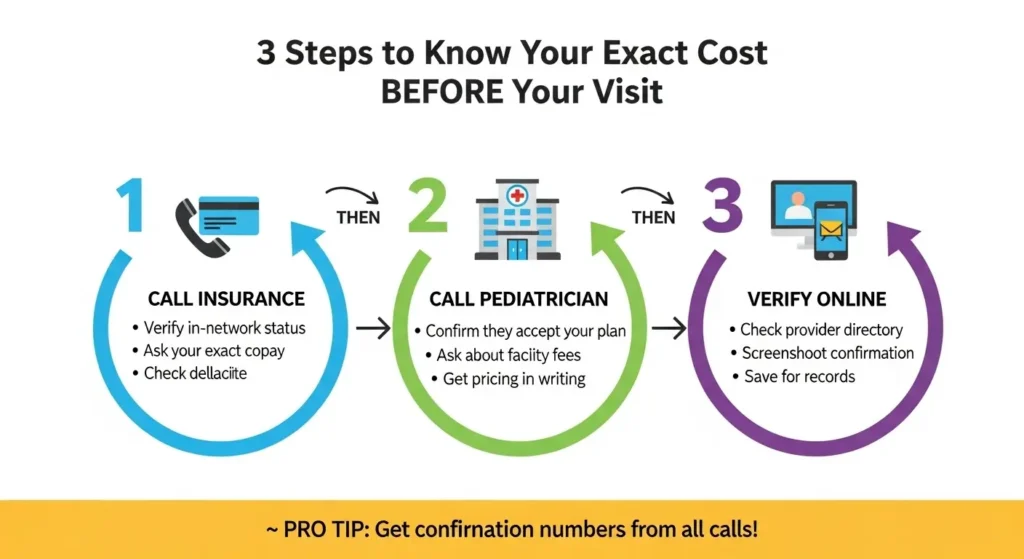
Step 1: Call Your Insurance Company
Before scheduling with any pediatrician, call the customer service number on your insurance card.
Questions to ask:
- “Is [pediatrician name/practice] in my network?”
- Verify this even if the office says they accept your insurance
- Get the representative’s name and confirmation number
- Networks change—verify before each visit with a new provider
- “What is my copay for pediatric office visits?”
- Primary care sick visit copay
- Specialist copay (if you need referrals)
- Urgent care copay
- Preventive care copay (should be $0)
- “Have I met my deductible for the year?”
- How much you’ve paid toward deductible
- How much remains
- Whether pediatric visits apply to deductible (most preventive visits don’t)
- “Do I need a referral to see a pediatrician?”
- Most plans don’t require referrals for pediatric primary care
- Some HMOs may require PCP designation
- Specialist referrals usually required
- “Are immunizations covered?”
- Should be free during well-child visits
- Ask about coverage if given during sick visits
- Verify specific vaccines if child needs catch-up immunizations
- “What’s my out-of-pocket maximum?”
- Maximum you’ll pay in one year
- Helpful for budgeting if child has chronic condition
Write down:
- Date and time of call
- Representative’s name
- Confirmation or reference number
- Answers to all questions
Pro tip: If the representative says the pediatrician is in-network but you’re unsure, ask for the specific provider ID or NPI number that matches your pediatrician.
Step 2: Call the Pediatrician’s Office
Armed with insurance information, call the pediatric practice before your first appointment.
Questions to ask:
- “Do you accept [your specific insurance plan]?”
- Don’t just ask if they accept “Blue Cross”—there are dozens of BCBS plans
- Provide your exact plan name from insurance card
- Ask if they’re in-network or out-of-network
- “What is the copay for [visit type]?”
- They should be able to tell you based on your insurance
- Ask about both sick visits and well-child visits
- Request written confirmation if possible
- “Is there a facility fee?”
- Hospital-affiliated practices may charge facility fees
- These can add $50-$200 to your bill
- Often not mentioned until you get the bill
- “What is your cash-pay rate if I don’t have insurance?”
- Get pricing for new patient, established patient, and well-child visits
- Ask about cash-pay discounts
- Inquire about payment plans
- “Do you offer payment plans?”
- Terms: How long? Interest?
- Minimum payment requirements
- Credit check required?
- “What vaccines will my child receive, and are they covered?”
- For well-child visits, get list of scheduled vaccines
- Verify coverage before visit
- Ask about any vaccines not covered by insurance
- “Do you participate in the Vaccines for Children program?”
- If your child qualifies, vaccines may be free
- VFC eligibility: Medicaid, uninsured, underinsured, American Indian/Alaska Native
Red flags:
- Office can’t or won’t quote prices
- Vague answers about insurance acceptance
- Resistance to questions about costs
- Consider finding a more transparent practice
Step 3: Verify In-Network Status Independently
Never rely solely on the doctor’s office confirmation. Verify in-network status yourself.
How to verify:
- Use your insurance company’s online provider directory:
- Login to insurer’s website
- Access “Find a Doctor” or “Provider Search”
- Search by pediatrician name, address, or NPI number
- Verify they’re listed as in-network
- Check for in-network date ranges:
- Some providers are in-network only for part of the year
- Verify current in-network status
- Ask about any upcoming network changes
- Verify the specific location:
- Multi-location practices may be in-network at some sites but not others
- Confirm the exact address where you’ll receive care
- Check for facility fee warnings:
- If practice is hospital-affiliated, look for notices about facility fees
- These fees can significantly increase costs
- Consider asking hospital billing department about typical facility fees
Download or print:
- Screenshot of provider directory showing in-network status
- Date you verified
- Keep for your records in case of billing disputes
Real example: Melissa found a pediatrician in Brooklyn who said they accepted her Oscar Health plan. She verified on Oscar’s website and discovered the practice was in-network—but only at their Manhattan location, not Brooklyn. She chose a different practice, saving herself 40% higher out-of-network costs.
Understanding Your Bill: Key Sections Explained
Medical bills confuse most people. Here’s how to read yours.
Section 1: Provider charges
- Amount the pediatrician billed
- This is often 2-3x what insurance actually pays
- You typically won’t pay this amount if you have insurance
Section 2: Insurance adjustment
- Amount insurance “writes off” as part of contracted rate
- This reduces provider charge to agreed-upon amount
- You never pay this portion
Section 3: Insurance payment
- What your insurance actually paid the provider
- May be subject to deductible and coinsurance
Section 4: Your responsibility
- What you owe
- Includes: copays, deductible, coinsurance
- This is your actual bill
Example bill breakdown:
Provider charges:               $275.00
Insurance adjustment:          -$125.00
Contracted rate:                $150.00
Insurance paid (80%):          -$120.00
Your copay:                     -$30.00
Your total responsibility:       $30.00
Understanding CPT codes:
Every service has a CPT (Current Procedural Terminology) code.
Common pediatric CPT codes:
- 99381-99395: Preventive care visits (well-child)
- 99201-99215: Office visits (sick visits, new patient)
- 90460-90461: Immunization administration
- 90633-90750: Specific vaccine codes
- 85025: Complete blood count (CBC)
- 87880: Strep test
Why codes matter:
- Determines what insurance pays
- Some codes are covered 100% (preventive)
- Others subject to copay/deductible (problem-focused)
How to read codes on your bill:
- Look for code number (5 digits)
- Google “CPT code [number]” to see what service was billed
- Verify you actually received that service
Red flags to watch for:
- Duplicate charges
- Same CPT code listed twice
- Common billing error
- Request correction
- Services not rendered
- Codes for tests or procedures you didn’t receive
- Verify each line item
- Dispute immediately
- Incorrect coding level
- Simple visit coded as complex (99215 instead of 99213)
- Increases cost by 40-60%
- Ask provider to review if seems wrong
- Balance billing (out-of-network)
- Provider charging you the difference between their fee and insurance payment
- Illegal in many situations in New York
- Contact your insurance and NY Department of Financial Services
- Facility fees not disclosed
- Hospital-affiliated practices may charge these
- Should be disclosed in advance
- Can add $50-$200 to bill
Your rights in New York:
- Right to itemized bill
- Right to explanation of charges
- Right to appeal insurance denials
- Protection from surprise billing (No Surprises Act)
If You Can’t Afford the Bill: Immediate Steps
Don’t panic and don’t ignore medical bills. You have options.
Action 1: Call the Billing Department Immediately
Why this matters:
- Shows good faith effort to resolve
- Prevents collections process
- Opens negotiation opportunity
What to say: “I received a bill for $[amount] but cannot afford to pay it all at once. What options are available?”
They may offer:
- Payment plans (0% interest, 3-24 months typical)
- Financial assistance application
- Cash-pay discount if you pay a portion upfront
- Charity care if you qualify
Be prepared to provide:
- Income information
- Family size
- Current financial situation
Don’t be afraid to negotiate:
- “Can you reduce this bill if I pay $X today?”
- “Can you extend the payment plan to 18 months?”
- “Is there a prompt-pay discount?”
Action 2: Request an Itemized Bill
Why:
- Reveals billing errors (common in 30-40% of bills)
- Shows exactly what you’re paying for
- Required for disputing charges
How to request:
- Call billing department
- Request “fully itemized bill with CPT codes”
- Get it in writing (email or mail)
Review carefully:
- Verify each service was actually provided
- Check for duplicate charges
- Ensure codes match services received
- Compare to your notes from the visit
Real example: Todd received a $425 bill for his daughter’s sick visit. The itemized bill showed he was charged for a comprehensive exam (99215) when she only had a simple ear infection check. He called, and they corrected it to 99213, reducing his bill to $275.
Action 3: Apply for Financial Assistance/Charity Care
Most hospitals and many private practices offer financial assistance programs.
Who qualifies:
- Typically families earning 200-400% of federal poverty level
- Some programs more generous (up to 500% FPL)
- Uninsured or underinsured patients prioritized
Income limits (2026):
Family of 4 federal poverty level = $31,200
- 200% FPL = $62,400 → Often qualify for 100% discount
- 300% FPL = $93,600 → Often qualify for 50-75% discount
- 400% FPL = $124,800 → May qualify for 25-50% discount
How to apply:
- Request application:
- Call hospital/practice financial counseling department
- Ask for “financial assistance application” or “charity care application”
- Available online at most hospital websites
- Gather documentation:
- Recent pay stubs (last 2-3 months)
- Tax returns (most recent year)
- Bank statements
- Proof of expenses (rent, utilities)
- Insurance denial letters if applicable
- Submit application:
- Complete thoroughly
- Include all requested documentation
- Keep copies for your records
- Submit within deadline (usually 30-90 days of service)
- Follow up:
- Call weekly to check status
- Response typically within 30 days
- Request written approval
Retroactive applications:
- Many programs accept applications after service
- Can apply up to 180 days after bill in many cases
- Stops collections while under review
Action 4: Negotiate a Cash-Pay Discount
If you can pay a portion immediately, you may secure significant discounts.
How it works:
- Practices save on billing and collection costs
- They prefer immediate payment to long payment plans
- Discounts range from 10-40%
How to negotiate:
Your opening: “I have $[amount] I can pay today. If I pay this now, can you settle the bill in full?”
Start low: If bill is $500, offer $300-$350
Be ready to meet in middle: They counter at $425, you settle at $375
Get it in writing: “Please send written confirmation that $[amount] settles this bill in full”
Pay only after receiving written agreement: Protects you from future collection attempts
Real example: Janine’s son had urgent care visit costing $350 without insurance. She offered $225 cash to settle immediately. After negotiation, they agreed to $275. She saved $75 (21% discount) and avoided a payment plan.
Action 5: Set Up a Payment Plan
If you can’t pay the full amount but can make monthly payments, most providers offer plans.
Typical terms:
- 0% interest (ask to confirm)
- 3-24 months duration
- Minimum payments: $25-$100/month
- No credit check at most practices
- Automatic payment options available
How to set up:
- Contact billing department: “I’d like to set up a payment plan”
- Propose monthly payment: “I can afford $50/month”
- Ask about terms:
- Is there interest?
- What’s the minimum payment?
- What happens if I miss a payment?
- Can I pay it off early without penalty?
- Get agreement in writing: Request payment plan terms via email or mail
- Set up auto-pay: Prevents missed payments
Protect yourself:
- Never agree to more than you can afford
- Ask about grace periods for missed payments
- Verify no interest or fees
- Keep records of all payments
If you can’t afford minimum payment:
- Ask about hardship programs
- Apply for financial assistance
- Explain your situation honestly
- Providers prefer small payments to no payments
Action 6: Dispute Billing Errors
Found errors on your bill? You have the right to dispute.
Common billing errors:
- Duplicate charges (same service billed twice)
- Services not received
- Incorrect coding (wrong CPT code or level)
- Insurance processed incorrectly
- Out-of-network charges when provider is in-network
How to dispute:
- Document the error:
- Note date of service
- What you actually received
- What you were billed for
- Why they don’t match
- Contact billing department:
- “I’m disputing charges on bill #[number]”
- Explain the error specifically
- Reference your documentation
- Submit written dispute:
- Email or letter
- Include supporting documents
- Request written response
- Follow up:
- Call weekly
- Document all conversations
- Don’t pay disputed charges until resolved
- Escalate if needed:
- Request supervisor
- Contact insurance company
- File complaint with NY Department of Financial Services
- Consider medical billing advocate
Sample dispute language:
“I am disputing the charge for CPT code 99215 on my bill dated [date]. My child had a routine ear infection check that should be coded as 99213, not a comprehensive high-complexity visit. Please review the medical record and correct this billing error.”
Keep records:
- All correspondence
- Names and dates of phone calls
- Written confirmations
- Corrected bills
Your protection: New York law requires providers to investigate billing disputes and respond in writing. Don’t pay disputed amounts until resolved.
Money-Saving Strategies for Pediatric Care in New York
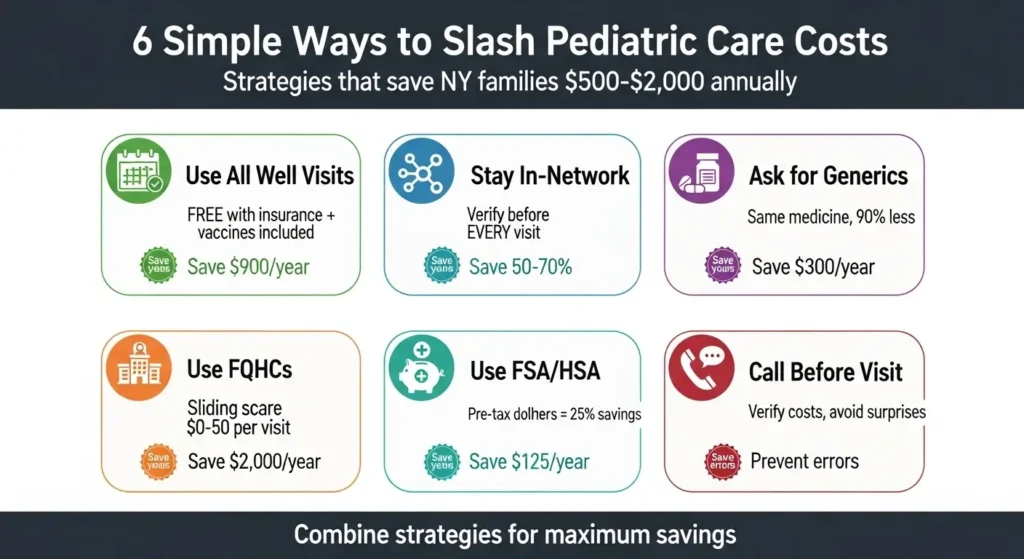
These proven strategies can reduce your pediatrician cost in New York by 50-80% annually, putting hundreds of dollars back in your family budget.
Maximize Your Insurance Benefits
If you have insurance, using it strategically saves the most money.
Strategy 1: Schedule All Recommended Well-Child Visits
Well-child visits are free with all ACA-compliant insurance—but only if you actually schedule them.
The recommended schedule:
- Ages 0-1: 7 visits (birth, 1m, 2m, 4m, 6m, 9m, 12m)
- Ages 1-2: 3 visits (15m, 18m, 24m)
- Ages 3+: Annual visits
Why this saves money:
- Preventive care is free: No copay, no deductible
- Catches problems early: Prevents expensive treatments later
- Vaccines included: $600-$1,200 value per year for infants
- Screenings included: Developmental, vision, hearing, lead tests all free
Cost comparison:
Family that skips well-child visits:
- Missed developmental delay (discovered later in ER): $2,000
- Delayed vaccines (catch-up at sick visit): $400 + copay
- Undiagnosed anemia (ER visit): $1,500
- Total unnecessary costs: $3,900+
Family that attends all well-child visits:
- 7 well visits with vaccines: $0
- Developmental delay caught early: Free
- Anemia detected and treated: $0
- Total cost: $0
How to remember:
- Set calendar reminders when scheduling
- Many practices send recall notices
- Bundle with birthday celebrations (“Doctor visit month!”)
Strategy 2: Always Use In-Network Providers
This single strategy saves 50-70% compared to out-of-network care.
In-network vs. out-of-network cost example:
Sick visit in Queens:
- In-network copay: $30
- Out-of-network: $175 (you pay difference after insurance)
- Savings: $145 per visit
Annual savings for family with 4 sick visits:
- In-network total: $120
- Out-of-network total: $700
- Savings: $580
How to stay in-network:
- Verify before every appointment:
- Check insurance website
- Call to confirm
- Networks change quarterly
- Get referrals to in-network specialists:
- Ask pediatrician for list
- Verify with insurance
- Don’t assume referred doctor is in-network
- Use in-network urgent care:
- Check insurance app for locations
- Keep list in phone for emergencies
- Verify in-network labs:
- If pediatrician orders lab work, confirm lab is in-network
- Quest Diagnostics and LabCorp contracts vary by insurance
Exception: Emergency care is covered at in-network rates even if hospital is out-of-network (thanks to No Surprises Act).
Strategy 3: Understand Visit Coding
How your pediatrician codes the visit affects your cost. Use this knowledge strategically.
The “combined visit” decision:
Your child has a scheduled well-child visit but also has a cold. You have three options:
Option A: Address both today
- Pediatrician codes: Preventive visit + problem-focused visit
- You pay: $0 (preventive) + $30 copay (problem) = $30
- Advantage: One trip, both issues addressed
- Disadvantage: Costs $30 instead of $0
Option B: Skip mentioning the cold
- Pediatrician codes: Preventive visit only
- You pay: $0
- Advantage: Free visit
- Disadvantage: Cold not addressed, may worsen
- Not recommended if child is truly ill
Option C: Reschedule well-child visit, today is sick visit
- Today coded as: Problem-focused visit
- You pay: $30 copay
- Schedule well visit: Next week at $0
- Advantage: Both issues properly addressed
- Disadvantage: Two appointments required
Best practice:
- Mention concerns when scheduling: “She’s due for well-child but also has a cough”
- Receptionist can advise best approach
- For minor issues (small rash, mild concern): Often fine to address in well visit
- For significant illness: Schedule separate sick visit
Maximize preventive visit value:
During well-child visits, you can discuss (without triggering sick visit codes):
- Growth and development questions
- Nutrition and feeding
- Sleep habits and schedules
- Behavioral concerns
- Safety (car seats, childproofing)
- School performance
- Developmental milestones
What triggers sick visit coding:
- Treatment of acute illness
- Prescription medications for current condition
- Detailed examination of specific problem
- Procedures beyond routine screening
Real example: At Lucas’s 4-year well-child visit, his mom asks about his picky eating, bedtime struggles, and whether his growth is normal. All addressed within the free well visit. Two weeks later, Lucas develops strep throat—that’s billed as a separate sick visit with $30 copay. Total annual cost: $30 instead of $60+ if she’d tried to address everything at sick visits.
For Uninsured Families: Maximizing Savings
Without insurance, you must be strategic about every healthcare dollar.
Strategy 1: Apply for Medicaid or Child Health Plus Immediately
Don’t assume you don’t qualify. New York’s income limits are generous.
Why this is strategy #1:
- Reduces costs to $0-$30 per visit
- Comprehensive coverage including dental, vision
- Retroactive coverage possible
- Free vaccines and medications
Income eligibility (family of 4, 2026):
- Medicaid: Up to $69,090 annually
- Child Health Plus: Up to $124,800 annually
“But I work full-time!”
- You can still qualify
- Many working families receive these benefits
- Part-time work, seasonal work, or lower wages often qualify
- Even moderate income may qualify for Child Health Plus
How to apply:
- Online: nystateofhealth.ny.gov
- Phone: 1-855-355-5777
- In person: Local Department of Social Services
- Free application assistance available
Processing time:
- Applications processed within 45 days
- Often faster for children
- Coverage can be retroactive to application date
Real example: The Garcia family earns $55,000 with two children. They assumed they wouldn’t qualify but applied anyway. Both children qualified for Child Health Plus at $15/month per child. Annual cost went from $2,500 (uninsured) to $360 (premiums) + $60 (copays) = $420. Savings: $2,080.
Strategy 2: Use Community Health Centers Exclusively
FQHCs offer the best value for uninsured families.
Why FQHCs save money:
- Sliding scale fees: $0-$50 per visit
- Income-based pricing
- Free vaccines through VFC program
- Comprehensive services (medical, dental, behavioral)
- Help applying for insurance
Cost comparison (uninsured family, 3 children, Bronx):
Private pediatrician:
- 6 well-child visits: $1,200
- 4 sick visits: $700
- Vaccines: $800
- Total: $2,700
Community health center:
- 6 well-child visits (sliding scale): $150
- 4 sick visits (sliding scale): $100
- Vaccines (VFC program): $0
- Total: $250
Savings: $2,450 (91% reduction)
How to find:
- HRSA locator: findahealthcenter.hrsa.gov
- Call 211
- Ask neighbors, community organizations
- See Section 5 for specific locations
First visit process:
- Bring income documentation
- Proof of address
- Children’s information
- They’ll calculate your sliding scale fee
- Get assigned fee schedule for future visits
Strategy 3: Separate Vaccines from Office Visits
Vaccines are often the most expensive part of pediatric care. Get them free, pay only for the exam.
How this works:
Traditional approach (private pediatrician, uninsured):
- 6-month well visit + vaccines: $250 + $400 = $650
Separated approach:
- County health department vaccines (VFC program): $0
- Community health center well visit: $25
- Total: $25
Savings: $625
Where to get free/low-cost vaccines:
- County health departments (VFC program)
- NYC Department of Health clinics
- Community health centers (often $0 for VFC-eligible)
- Some pharmacies (ages 3+, limited selection)
VFC eligibility:
- Medicaid-enrolled
- Uninsured
- Underinsured (insurance doesn’t cover vaccines)
- American Indian/Alaska Native
Process:
- Schedule well-child visit at affordable provider
- Get free vaccines at health department
- Bring vaccine records to well-child visit
- Pediatrician reviews records, confirms child is up-to-date
Important: Some pediatricians require vaccines be given in their office. Ask their policy beforehand.
Real example: The Chen family in Queens has no insurance. Instead of paying $750 for their baby’s 2-month visit with vaccines at a private pediatrician, they get free vaccines at Queens County Health Department and a $25 well-child exam at a community health center. Total: $25 vs. $750. Savings: $725.
Strategy 4: Negotiate Cash-Pay Discounts
Paying cash upfront often yields 10-30% discounts.
Why providers offer discounts:
- Eliminates billing costs ($20-$40 per claim)
- Avoids insurance payment delays (30-90 days)
- Reduces collection risk
- Cash flow improvement
How to negotiate:
Before the visit:
- Call and ask: “What’s your cash-pay rate for [visit type]?”
- “Do you offer a discount for paying at time of service?”
- “I can pay $[amount] today. What can you do for me?”
Most effective approach:
- Be polite but direct
- Emphasize immediate payment
- Ask to speak with office manager or billing specialist
- Don’t be afraid to compare with other practices
What to expect:
- Simple sick visit: 15-25% discount typical
- Well-child visit: 10-20% discount
- Larger bills (procedures): Up to 30-40% discount possible
Get written confirmation:
- “Please provide written confirmation of the cash-pay price”
- Keep for records
- Protects against future billing
Real example: David in Syracuse needs to bring his daughter for a sick visit. The regular uninsured rate is $150. He calls ahead and asks about cash-pay discounts. They offer $120 if he pays at time of service. He saves $30 (20%) simply by asking.
General Cost-Saving Tips for All Families
These strategies work whether you have insurance or not.
Timing Matters
Schedule strategically:
Early week appointments:
- Avoid weekend urgent care surcharges
- Better availability
- More time to get prescriptions filled
First appointment of the day:
- Less waiting time
- Doctor isn’t running behind
- Fresh attention
Off-peak seasons:
- Summer often less crowded
- Easier to get appointments
- May have more time with provider
Use Telehealth for Minor Issues
Many concerns don’t require in-person visits.
Perfect for telehealth:
- Minor rashes (can show via video)
- Medication questions
- Follow-up on improving condition
- Feeding/nutrition questions
- Behavioral concerns
- Sleep issues
Cost comparison:
- In-person visit: $30-$50 copay (or $150-$250 uninsured)
- Telehealth visit: $0-$30 copay (or $40-$75 uninsured)
- Savings: $20-$175 per visit
Insurance coverage:
- Most plans cover telehealth same as in-person
- Check your specific plan
- Some charge slightly lower copays for telehealth
Availability:
- Many practices offer telehealth
- Same-day appointments often available
- Evening/weekend options common
Ask Before Additional Services
Every test, procedure, or service adds cost.
Questions to ask:
“Is this test necessary?”
- Providers often order tests out of abundance of caution
- Some are essential; others are optional
- You have the right to understand why
“What will this cost?”
- Ask before agreeing to any test/procedure
- Especially important if you haven’t met deductible
“Will insurance cover this?”
- Not all tests covered by all plans
- Find out before, not after
“What happens if we don’t do this test?”
- Understand the risks and benefits
- Make informed decision
“Can we wait and see if symptoms improve?”
- Some conditions resolve without intervention
- “Watchful waiting” sometimes appropriate
Real example: Emma’s pediatrician suggests blood work to check for anemia because Emma seems pale. Emma’s mom asks, “Is this necessary or precautionary?” Doctor explains it’s precautionary given family history. Mom asks cost: $85 with her insurance. She decides to improve Emma’s diet first, recheck in 2 weeks. Pale appearance was just winter skin. Saved $85.
Use FSA/HSA Accounts
If your employer offers Flexible Spending Accounts (FSA) or Health Savings Accounts (HSA), maximize them.
How they work:
- Pre-tax dollars set aside for medical expenses
- Reduces taxable income
- Saves 20-35% depending on tax bracket
What’s covered for pediatric care:
- Copays
- Deductibles
- Coinsurance
- Prescription medications
- Over-the-counter medications (with prescription)
- Medical equipment (thermometers, bandages, etc.)
Example savings:
Without FSA:
- Annual pediatric costs: $500
- Paid with after-tax dollars
- Tax bracket: 25%
- Actual cost: $500
With FSA:
- Annual pediatric costs: $500
- Paid with pre-tax dollars
- Effective cost: $375 (25% tax savings)
- Savings: $125
How to maximize:
- Estimate annual pediatric costs
- Contribute that amount to FSA/HSA
- Use FSA/HSA debit card for all medical expenses
- Keep receipts for documentation
FSA vs. HSA:
- FSA: Use it or lose it annually, available with any health plan
- HSA: Rolls over year to year, requires high-deductible health plan, can invest for growth
Choose Generic Prescriptions
When your pediatrician writes a prescription, always ask for generic.
Cost savings:
- Generic: 50-90% cheaper than brand name
- Same active ingredients
- FDA-approved equivalent effectiveness
Examples:
Amoxicillin (antibiotic):
- Brand name: $25-$40
- Generic: $4-$10
- Savings: $15-$30
Albuterol inhaler (asthma):
- Brand name (Ventolin): $60-$80
- Generic albuterol: $30-$50
- Savings: $30
Cetirizine (allergy):
- Brand name (Zyrtec): $15-$20
- Generic: $5-$8
- Savings: $10
How to ensure generic:
- “Please write this as generic”
- Verify at pharmacy before filling
- Ask pharmacist for generic version if not specified
When brand may be necessary:
- Some medications don’t have generics
- Doctor specifies “brand necessary” (rare)
- Child has specific reaction to generic formulation (very rare)
Real example: Miguel’s son needs an asthma medication. The brand-name prescription would cost $80. Miguel asks the pediatrician, “Is there a generic?” Yes—generic version costs $35. Miguel saves $45 every month = $540 annually.
Common Scenarios & What You’ll Actually Pay
Let’s look at real-world examples of pediatrician cost in New York across different situations.
Scenario 1: 2-Month Well-Baby Visit with Good Insurance (Queens)
The situation: Baby Sophia is 2 months old. Parents have Anthem BCBS through employer.
The visit includes:
- Complete physical exam
- Developmental screening
- Growth measurements
- Parental guidance
- 5 vaccines: DTaP, Hib, Hepatitis B, Pneumococcal, Rotavirus, Polio
The bill:
- Pediatrician charges: $275 (office visit) + $650 (vaccines) = $925
- Insurance adjustment: -$425
- Insurance approved amount: $500
- Insurance pays (100% preventive): $500
- Parent pays: $0
Why it’s free:
- Well-child visit = preventive care
- All ACA plans cover at 100%
- In-network provider
Annual projection:
- 3 more well visits this year: $0 each
- Total first-year well-child cost: $0
Scenario 2: 2-Month Well-Baby Visit WITHOUT Insurance (Manhattan)
The situation: Baby Noah is 2 months old. Parents are between jobs, no current insurance.
Traditional approach (private pediatrician in Manhattan):
- Office visit: $300
- 5 vaccines: $550-$750
- Total: $850-$1,050
Smart approach (using free resources):
- Vaccines at NYC Health Department clinic: $0
- Well-child visit at community health center: $0-$25 (sliding scale)
- Total: $0-$25
Savings: $825-$1,050
What they did:
- Visited Charles B. Wang Community Health Center
- Provided income documentation
- Qualified for sliding scale fee of $0
- Received all vaccines through VFC program
- Total cost: $0
Scenario 3: Sick Visit for Ear Infection with Insurance (Buffalo)
The situation: 7-year-old Aiden has ear pain and fever. Parents have Excellus BCBS.
The visit includes:
- Physical exam focused on ears, nose, throat
- Ear examination with otoscope
- Diagnosis: Acute otitis media (ear infection)
- Prescription: Amoxicillin antibiotic
The bill:
- Pediatrician charges: $175
- Insurance adjustment: -$50
- Insurance approved amount: $125
- Insurance pays: $95
- Parent copay: $30
- Prescription (generic): $8
- Total out-of-pocket: $38
If out-of-network:
- Parent pays: $175 (full charge) – $95 (insurance) = $80
- Prescription: $8
- Total: $88
- Extra cost for out-of-network: $50
Scenario 4: Sick Visit for Ear Infection WITHOUT Insurance (Brooklyn)
The situation: 7-year-old Isabella has ear infection. Family has no insurance.
Private pediatrician option:
- Office visit: $200
- Amoxicillin prescription: $12
- Total: $212
Community health center option:
- Office visit (sliding scale, moderate income): $35
- Amoxicillin prescription: $12
- Total: $47
What makes the difference:
- Family earns $58,000 (family of 4)
- Income is 186% of federal poverty level
- Qualifies for reduced fees at FQHC
- Pediatrician noted child qualifies for Child Health Plus
- Family applied and now has $15/month coverage
After getting Child Health Plus:
- Monthly premium: $15
- Office visit copay: $15
- Prescription: $0
- Total: $30
Long-term savings by getting insurance:
- Annual premium: $180
- Expected 3 sick visits: $45
- 1 well visit: $0
- Annual cost with insurance: $225
- Annual cost without (3 sick + 1 well at FQHC): $200
Note: Even though slightly more expensive, insurance provides catastrophic protection and specialist coverage worth having.
Scenario 5: First Year of Pediatric Care – Complete Breakdown
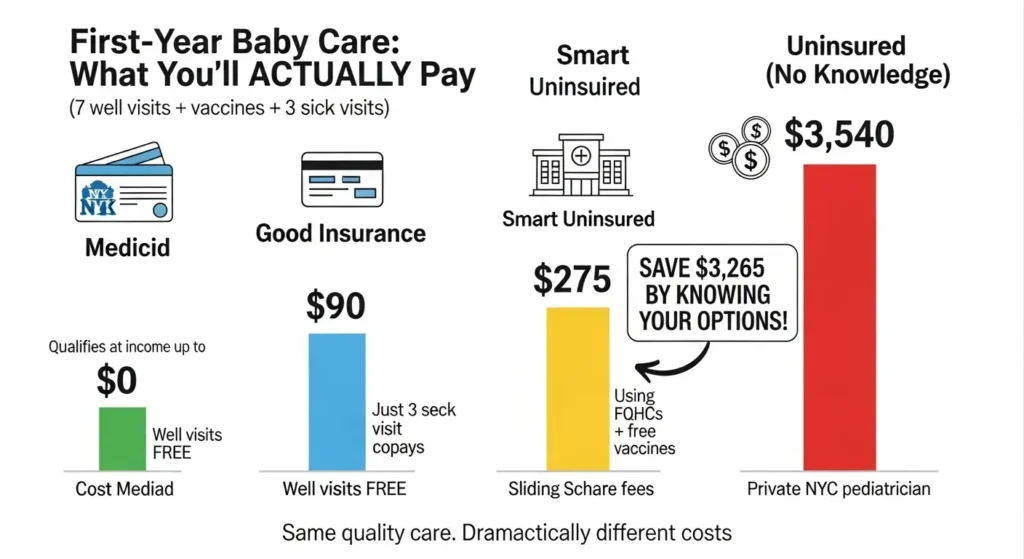
The situation: Baby Emma, born healthy in Manhattan. Let’s compare three families’ first-year costs.
Family A: Good Insurance (UnitedHealthcare PPO)
Well-child visits (7 visits):
- All covered at $0 (preventive care)
- Includes all vaccines
- Cost: $0
Sick visits (average 3 in first year):
- Copay: $30 each
- Cost: $90
One urgent care visit (weekend):
- Copay: $75
- Cost: $75
Prescriptions (2 antibiotics, gas drops):
- Cost: $20
Annual premium contribution:
- Employer covers most, family pays $150/month
- Cost: $1,800
Total first-year cost: $1,985
Family B: Medicaid
Well-child visits (7 visits):
- Cost: $0
Sick visits (3 visits):
- Cost: $0
Urgent care visit:
- Cost: $0
Prescriptions:
- Cost: $0
Premium:
- Cost: $0
Total first-year cost: $0
Family C: No Insurance, Using Smart Strategies
Well-child visits (7 visits at FQHC):
- Sliding scale at $20 per visit
- Cost: $140
Vaccines (through VFC program):
- Cost: $0
Sick visits (3 visits at FQHC):
- Sliding scale at $25 per visit
- Cost: $75
Urgent care visit (community health center weekend hours):
- Cost: $35
Prescriptions (generics at discount pharmacy):
- Cost: $25
Total first-year cost: $275
Family D: No Insurance, No Knowledge of Resources
Well-child visits (7 visits at private Manhattan pediatrician):
- Average $250 per visit
- Cost: $1,750
Vaccines:
- Included in well visits
- Cost: $800
Sick visits (3 visits):
- Average $225 per visit
- Cost: $675
Urgent care visit:
- Cost: $275
Prescriptions:
- Cost: $40
Total first-year cost: $3,540
Comparison:
- Family D pays $3,265 MORE than Family C
- Simply by lacking knowledge of available resources
- This is why this guide exists
Scenario 6: Specialist Referral for Allergies
The situation: 5-year-old Lucas has persistent rashes and suspected food allergies. Pediatrician refers to pediatric allergist.
With Insurance (Aetna HMO, Westchester)
Pediatrician visit (referral):
- Copay: $30
Pediatric allergist initial visit:
- Specialist copay: $50
Allergy skin prick testing (15 allergens):
- Insurance negotiated rate: $400
- Patient responsibility after deductible: $80 (20% coinsurance)
Follow-up allergist visit:
- Specialist copay: $50
EpiPen prescription:
- Brand: $350
- Generic: $150
- With insurance: $40
Total cost: $250
Without Insurance (Used Smart Resources)
Pediatrician visit at FQHC:
- Sliding scale: $30
Pediatric allergist at hospital charity care program:
- Applied for financial assistance
- Qualified at 250% FPL
- 75% discount approved
Allergy testing:
- Full price: $600
- After charity care discount (75%): $150
Follow-up visit:
- After discount: $50
EpiPen prescription:
- Generic with GoodRx coupon: $110
Total cost: $340
Still higher than insured cost, but $750+ cheaper than full uninsured price
Scenario 7: Chronic Condition Management (Asthma)
The situation: 9-year-old Mia has asthma requiring regular care.
First Year After Diagnosis – With Insurance (Annual Costs)
Well-child visit:
- Copay: $0 (preventive)
Asthma follow-up visits (4 per year):
- Copay: $30 each
- Cost: $120
Pulmonologist specialist (2 visits):
- Specialist copay: $50 each
- Cost: $100
Medications:
- Albuterol inhaler (rescue): $30 × 3 = $90
- Fluticasone inhaler (controller): $40 × 6 = $240
- Copay per fill
Total: $330
Peak flow meter:
- $25
Annual asthma care cost: $575
First Year After Diagnosis – Medicaid
All visits: $0
All medications: $0
Equipment: $0
Annual asthma care cost: $0
First Year After Diagnosis – No Insurance, Smart Resources
Well-child visit (FQHC):
- Sliding scale: $25
Asthma follow-up visits (FQHC, 4 visits):
- Sliding scale: $30 each = $120
Pulmonologist (hospital charity care):
- 2 visits at 50% discount
- $150 each, discounted to $75 each = $150
Medications (generic with discount programs):
- Albuterol: $15 × 3 = $45
- Fluticasone generic: $25 × 6 = $150
Peak flow meter: $25
Annual asthma care cost: $515
Comparable to insured cost when using available resources
Frequently Asked Questions About Pediatrician Cost in New York
How much does a pediatrician visit cost in New York without insurance?
Without insurance, pediatrician cost in New York ranges from $100-$500 depending on location and visit type. Manhattan averages $200-$350 for sick visits, while upstate cities like Buffalo and Syracuse run $100-$200. Well-child visits cost $150-$300 in NYC and $100-$200 upstate.
However, you have affordable alternatives. Community health centers (FQHCs) offer sliding-scale fees from $0-$50 per visit based on income. NYC Health + Hospitals provides care on a sliding scale that can reduce costs to $0. County health departments offer free or low-cost vaccines and some pediatric services.
If you’re uninsured, apply for Medicaid (free for qualifying families) or Child Health Plus ($0-$60/month premium) immediately. Both provide comprehensive coverage and can be retroactive to your application date.
Are well-child visits free with insurance in New York?
Yes. All ACA-compliant health insurance plans in New York cover well-child visits at 100% with no copay, deductible, or coinsurance when you use an in-network provider. This includes all recommended well-child visits from birth through age 21, following the American Academy of Pediatrics schedule.
Well-child visit coverage also includes:
- Standard vaccinations administered during the visit
- Developmental and behavioral screenings
- Vision and hearing tests
- Growth measurements
- Age-appropriate health counseling
The visit must be coded as preventive care (CPT codes 99381-99395). If you mention current illness or the doctor treats an acute problem during the visit, part of it may be billed as a sick visit, triggering your copay.
To keep it free: Schedule separate appointments for well-child exams and sick visits when possible.
Does Medicaid cover pediatrician visits in New York?
Yes. New York Medicaid provides comprehensive pediatric coverage with $0 copays for all services, including:
- All well-child visits
- Sick visits
- Specialist referrals
- Immunizations
- Lab tests and X-rays
- Prescriptions
- Emergency care
- Dental and vision care
Children under 19 in families earning up to 223% of the federal poverty level qualify. For a family of four in 2026, that’s annual income up to $69,090.
Important consideration: Not all private pediatricians accept Medicaid. Community health centers, NYC Health + Hospitals facilities, and many group practices do accept it. Always call ahead to verify the pediatrician accepts Medicaid before your appointment.
Apply at mybenefits.ny.gov or call 1-855-355-5777.
How can I find a low-cost pediatrician in New York?
The best options for low-cost pediatric care in New York are:
1. Federally Qualified Health Centers (FQHCs)
- Sliding scale fees based on income ($0-$50 typically)
- Find locations at findahealthcenter.hrsa.gov
- Provide comprehensive care regardless of ability to pay
2. NYC Health + Hospitals
- 11 hospitals and 50+ community health centers
- Income-based sliding scale
- Many services free for low-income families
- Call 844-NYC-4NYC or visit nychealthandhospitals.org
3. County Health Departments
- Free or low-cost vaccines
- Some offer well-child visits
- Available in all 62 NY counties
4. Apply for Medicaid or Child Health Plus
- Medicaid: Free for qualifying families (income up to $69,090 for family of 4)
- Child Health Plus: $0-$60/month (income up to $124,800 for family of 4)
- Apply at nystateofhealth.ny.gov
5. School-Based Health Centers
- 350+ locations across NY
- Free or very low-cost
- Convenient during school hours
Don’t pay high prices when these resources exist. Thousands of New York families use them for quality pediatric care.
What’s the difference between a pediatrician copay and deductible?
Copay:
- Fixed amount you pay per visit (like $30)
- Due at time of service
- Same amount regardless of what doctor charges
- Example: Your plan has $30 pediatrician copay—you pay $30 whether the visit costs $150 or $300
Deductible:
- Total amount you must pay out-of-pocket before insurance starts paying
- Applies annually (resets January 1st)
- Ranges from $500-$5,000 for family plans
- Example: $2,000 deductible means you pay the first $2,000 of covered medical costs each year
Key difference for pediatric care:
- Sick visits: Usually just copay (deductible typically doesn’t apply to primary care copays)
- Well-child visits: $0 copay and exempt from deductible (preventive care)
- Specialist visits: May require copay AND deductible
- Lab tests/procedures: Often apply to deductible
Real example: Your plan has $30 copay and $2,000 deductible. Your child’s sick visit costs $30 copay only. But if your child needs $500 specialist visit and you haven’t met your deductible, you pay the full $500 (counts toward deductible).
Once you meet your deductible, you typically pay only copays or coinsurance (like 20% of costs).
Do all pediatricians in New York accept Medicaid?
No. While many pediatricians accept Medicaid, not all do—especially in private practices in affluent areas.
Who typically accepts Medicaid:
- Community health centers (FQHCs) – Always
- NYC Health + Hospitals facilities – Always
- Hospital-affiliated pediatric practices – Usually
- Multi-specialty group practices – Often
- County health department clinics – Always
Who may not accept Medicaid:
- Solo private practices in wealthy neighborhoods
- Concierge/boutique pediatric practices
- Some suburban practices
Geographic acceptance patterns:
- High acceptance: Bronx, Brooklyn, Queens, upstate cities
- Moderate acceptance: Manhattan (varies by neighborhood), Long Island
- Lower acceptance: Upper East Side Manhattan, Westchester affluent areas, North Shore Long Island
How to find Medicaid-accepting pediatricians:
- Use NY Medicaid provider directory online
- Call practices directly: “Do you accept NY Medicaid?”
- Ask for referrals from community health centers
- Contact your Medicaid managed care plan for provider list
Important: Pediatricians cannot discriminate against existing patients who become Medicaid-eligible. If you’re already established with a pediatrician and then qualify for Medicaid, they must continue treating your child.
If you have trouble finding a Medicaid-accepting pediatrician, community health centers provide excellent care and always accept Medicaid.
Can I negotiate pediatrician costs in New York?
Yes, especially if paying cash or facing financial hardship.
Most effective negotiations:
1. Cash-pay discounts (10-30% typical)
- “What’s your cash-pay rate?”
- “I can pay $X today to settle this bill. Is that acceptable?”
- Best results when offering immediate payment
2. Payment plans
- “I can’t pay $500 at once, but I can pay $75/month”
- Most practices offer 0% interest plans
- Negotiate terms that work for your budget
3. Bill reduction for errors
- Review itemized bill carefully
- Dispute any errors or duplicate charges
- Request correction before paying
4. Financial hardship discounts
- Explain your situation honestly
- Many practices have hardship policies
- Can reduce bills 20-50% for qualifying patients
What you can’t negotiate:
- Insurance-contracted rates (copays are fixed)
- In-network pricing (set by insurance contracts)
- Preventive care coverage ($0 is already the best deal)
Best practices for negotiating:
- Be polite and respectful
- Explain financial situation clearly
- Offer specific payment you can afford
- Get any agreement in writing
- Don’t agree to more than you can pay
Real example: Bill for $400. Patient offers $250 cash today. After discussion, they settle at $300—25% discount. Patient saves $100; practice gets immediate payment without billing costs.
How much do pediatric vaccines cost without insurance in NY?
Individual vaccines range from $25-$250 each without insurance. The complete first-year vaccine schedule costs $600-$1,200 if paying out-of-pocket.
Individual vaccine costs:
- DTaP: $70-$100
- Hepatitis A: $50-$75
- Hepatitis B: $40-$75
- Hib: $60-$90
- HPV: $200-$250
- Influenza (flu): $25-$50
- MMR: $75-$100
- Meningococcal: $100-$150
- Pneumococcal (PCV13): $150-$200
- Polio: $50-$75
- Rotavirus: $100-$150
- Varicella (chickenpox): $90-$120
Free vaccine options in New York:
Vaccines for Children (VFC) Program:
- Provides free vaccines to eligible children
- Eligibility: Medicaid-enrolled, uninsured, underinsured, or American Indian/Alaska Native
- Available at health departments, FQHCs, and enrolled pediatricians
County health departments:
- Free or low-cost ($0-$20) vaccines
- Walk-in clinics in all 62 counties
- No appointment needed at many locations
NYC Department of Health:
- Free vaccine clinics throughout five boroughs
- Serves all children regardless of insurance or immigration status
Community health centers:
- Provide VFC vaccines at no charge for eligible children
- Nominal administration fees ($0-$10) for some centers
Don’t pay hundreds for vaccines when free options exist. Call your county health department or visit findahealthcenter.hrsa.gov to locate free vaccine providers.
Is it cheaper to go to urgent care or a pediatrician in New York?
For routine sick visits, your pediatrician is cheaper. For after-hours emergencies, urgent care is cheaper than the ER but more expensive than regular office visits.
Cost comparison:
Regular pediatrician office visit:
- With insurance: $20-$50 copay
- Without insurance: $100-$250
- Best for: Non-emergency illness during office hours
Pediatric urgent care:
- With insurance: $50-$100 copay (higher than regular visit)
- Without insurance: $150-$300
- Best for: After-hours or weekend non-emergency issues
Emergency room:
- With insurance: $150-$300 copay
- Without insurance: $500-$3,000+
- Only for: True medical emergencies
Cost-saving strategy:
- During office hours: Always use your regular pediatrician first
- After hours, minor issue: Call pediatrician’s after-hours line (often free telephone advice)
- After hours, needs evaluation: Use urgent care, not ER
- True emergency: ER is appropriate (and ER copay is waived if admitted)
Examples:
Ear infection at 10 AM: Pediatrician visit = $30 copay
Ear infection at 8 PM: Urgent care = $75 copay (or call after-hours line first for advice)
Suspected broken arm: Urgent care with X-ray capability = $100 copay
Difficulty breathing: Emergency room = appropriate regardless of cost
Real example: Saturday evening, child develops 103°F fever. Parent calls pediatrician’s after-hours line (free). Nurse advises Tylenol and monitoring. If fever exceeds 105°F or child becomes lethargic, go to urgent care. Fever breaks overnight. Cost: $0 instead of $100+ urgent care visit.
What should I do if I can’t afford my pediatrician bill?
Don’t panic and don’t ignore it. You have multiple options:
Immediate actions:
1. Call the billing department
- Explain your situation honestly
- Ask about payment plans (usually 0% interest)
- Most practices work with you
2. Request an itemized bill
- Check for errors (found in 30-40% of bills)
- Dispute any incorrect charges
- Verify services were actually received
3. Apply for financial assistance
- Hospitals and many practices have charity care programs
- Can reduce bills 25-100% based on income
- Usually available to families earning up to 400% of federal poverty level ($124,800 for family of 4)
4. Negotiate
- Offer cash payment at reduced amount
- “I can pay $X today to settle this bill”
- Many providers accept 50-75% to avoid collection costs
5. Set up payment plan
- Most practices offer $25-$100/month plans
- Usually no interest if you make consistent payments
- Get terms in writing
Resources:
If bills are ongoing and you’re uninsured:
- Apply for Medicaid or Child Health Plus immediately
- Visit nystateofhealth.ny.gov or call 1-855-355-5777
- Coverage can be retroactive
If you have insurance but bills are high:
- Verify services were in-network
- Check if you’re being incorrectly balance-billed
- Contact your insurance to dispute charges
What NOT to do:
- Ignore the bills (goes to collections, damages credit)
- Pay with high-interest credit cards (creates bigger problem)
- Agree to payment you can’t afford
Real example: $850 bill for well-child visit that should have been free. Parent called insurance company—visit was incorrectly coded as “sick visit.” Insurance company fixed the coding, bill reduced to $0.
Resources & Next Steps
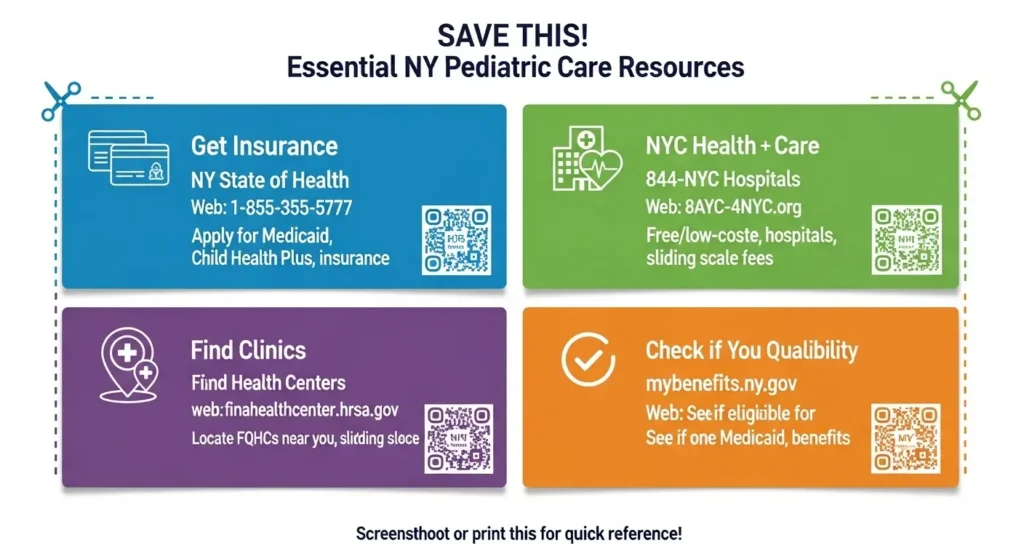
You now understand pediatrician cost in New York and how to afford quality care for your child. Here are the resources to take action.
Find Affordable Care
NY State of Health (Health Insurance Marketplace):
- Website: nystateofhealth.ny.gov
- Phone: 1-855-355-5777
- Services: Apply for insurance, Medicaid, Child Health Plus
- Free application assistance available
- Open enrollment: November 1 – January 31 annually
- Special enrollment periods for qualifying life events (job loss, moving, having baby)
HRSA Health Center Locator:
- Website: findahealthcenter.hrsa.gov
- Find Federally Qualified Health Centers near you
- Filter by pediatric services
- Shows sliding scale fee information
NYC Health + Hospitals:
- Website: nychealthandhospitals.org
- Phone: 844-NYC-4NYC (844-692-4692)
- 11 hospitals, 50+ health centers across five boroughs
- Income-based sliding scale
- No one turned away for inability to pay
County Health Departments:
- Find your county: health.ny.gov/health_care/medicaid/ldss.htm
- Free/low-cost vaccines
- Some offer well-child services
- WIC programs with health screenings
School-Based Health Centers:
- NYC: schools.nyc.gov/school-life/health-and-wellness/school-based-health-centers
- Upstate: Ask your child’s school or search “[city name] school-based health center”
Verify Insurance Coverage
Major insurance provider directories:
- Anthem Blue Cross Blue Shield: anthem.com/find-care
- UnitedHealthcare: uhc.com/find-a-physician
- Aetna: aetna.com/docfind
- Cigna: cigna.com/find-care-costs
- EmblemHealth: emblemhealth.com/find-a-doctor
- Oscar Health: hioscar.com/find-a-doctor
- Fidelis Care: fideliscare.org/find-a-provider
To verify in-network status:
- Login to your insurance website
- Navigate to “Find a Doctor” or “Provider Search”
- Enter pediatrician’s name and location
- Confirm they’re listed as in-network
- Print or screenshot for your records
Financial Assistance Applications
Medicaid eligibility calculator:
- Access My Benefits: mybenefits.ny.gov
- Determine if you qualify before applying
- Takes 5 minutes
Child Health Plus information:
- Phone: 1-800-698-4543
- Website: health.ny.gov/health_care/child_health_plus
- Income guidelines and application
Hospital charity care:
- Contact hospital’s financial counseling department
- Request financial assistance application
- Provide income documentation
- Submit within 180 days of service (policies vary)
Additional Helpful Resources
American Academy of Pediatrics:
- Website: healthychildren.org
- Vaccine schedules and explanations
- What to expect at well-child visits
- Developmental milestones
- Find a pediatrician tool
New York State Department of Health:
- Website: health.ny.gov
- Child health insurance programs
- Immunization requirements and schedules
- Public health resources
- County health department directory
NYC Department of Health and Mental Hygiene:
- Website: nyc.gov/health
- Free vaccine clinic locations and schedules
- School-based health center listings
- Child health resources
- Poison control, lead testing, and more
Immunization Action Coalition:
- Website: immunize.org
- Vaccine information sheets
- Immunization schedules in multiple languages
- Resources for parents
New York State of Health Navigator:
- Free, in-person help with insurance applications
- Find local navigator: info.nystateofhealth.ny.gov/IPANavigator
- Assistance in multiple languages
- Help understanding insurance options
GoodRx (Prescription Discount Program):
- Website: goodrx.com
- Free prescription price comparison
- Discount coupons (save 50-80% on medications)
- Shows prices at pharmacies near you
NeedyMeds:
- Website: needymeds.org
- Database of patient assistance programs
- Free/low-cost clinic directory
- Prescription assistance programs
Conclusion
Understanding pediatrician cost in New York empowers you to make informed healthcare decisions for your child without breaking your budget.
Key takeaways:
1. Costs vary dramatically by location Manhattan pediatrician visits can cost 2-3 times more than upstate cities. ZIP code matters.
2. Insurance changes everything With insurance, well-child visits cost $0 and sick visits run $20-$50. Without insurance, you’ll pay $100-$500 per visit at private practices.
3. Free and low-cost options exist everywhere Medicaid, Child Health Plus, community health centers, NYC Health + Hospitals, county health departments, and school-based health centers ensure every New York child can access quality care.
4. Knowledge saves money Families using the strategies in this guide save $1,000-$3,000 annually compared to those who don’t know their options.
5. Don’t let cost prevent care Your child’s health is too important. New York offers extensive resources to help families afford pediatric care regardless of income or insurance status.
Your next steps:
If you have insurance:
- Verify your pediatrician is in-network
- Schedule all recommended well-child visits (they’re free)
- Understand your copays and deductibles
- Use preventive care to maximum benefit
If you don’t have insurance:
- Apply for Medicaid or Child Health Plus today (nystateofhealth.ny.gov)
- Find a community health center near you (findahealthcenter.hrsa.gov)
- Get free vaccines at your county health department
- Don’t delay care—sliding scale options available immediately
If you’re struggling with bills:
- Call billing departments and negotiate
- Apply for financial assistance/charity care
- Set up affordable payment plans
- Never ignore medical bills
The bottom line: Quality pediatric care is available and affordable in New York when you know where to look and how to navigate the system.
Your child deserves excellent healthcare. This guide has given you the knowledge to provide it without financial stress.
Share this guide with other New York parents who need help understanding pediatric costs. Together, we can ensure every child in New York receives the healthcare they need.
Disclaimer: This guide provides general information about pediatrician costs in New York as of January 2026. Actual costs vary by provider, insurance plan, and individual circumstances. Always verify pricing with your specific healthcare provider and insurance company before receiving services. This information is for educational purposes and does not constitute medical or financial advice.
For medical decisions, always consult your child’s pediatrician. For insurance questions, contact your insurance company directly.
About This Guide
This comprehensive resource was created to address the lack of transparent, actionable information about pediatric healthcare costs in New York. Every New York parent deserves to know what they’ll pay and how to access affordable care for their children.
We’ve compiled data from insurance companies, healthcare providers, government agencies, and real families across New York State to provide the most accurate, up-to-date cost information available.